
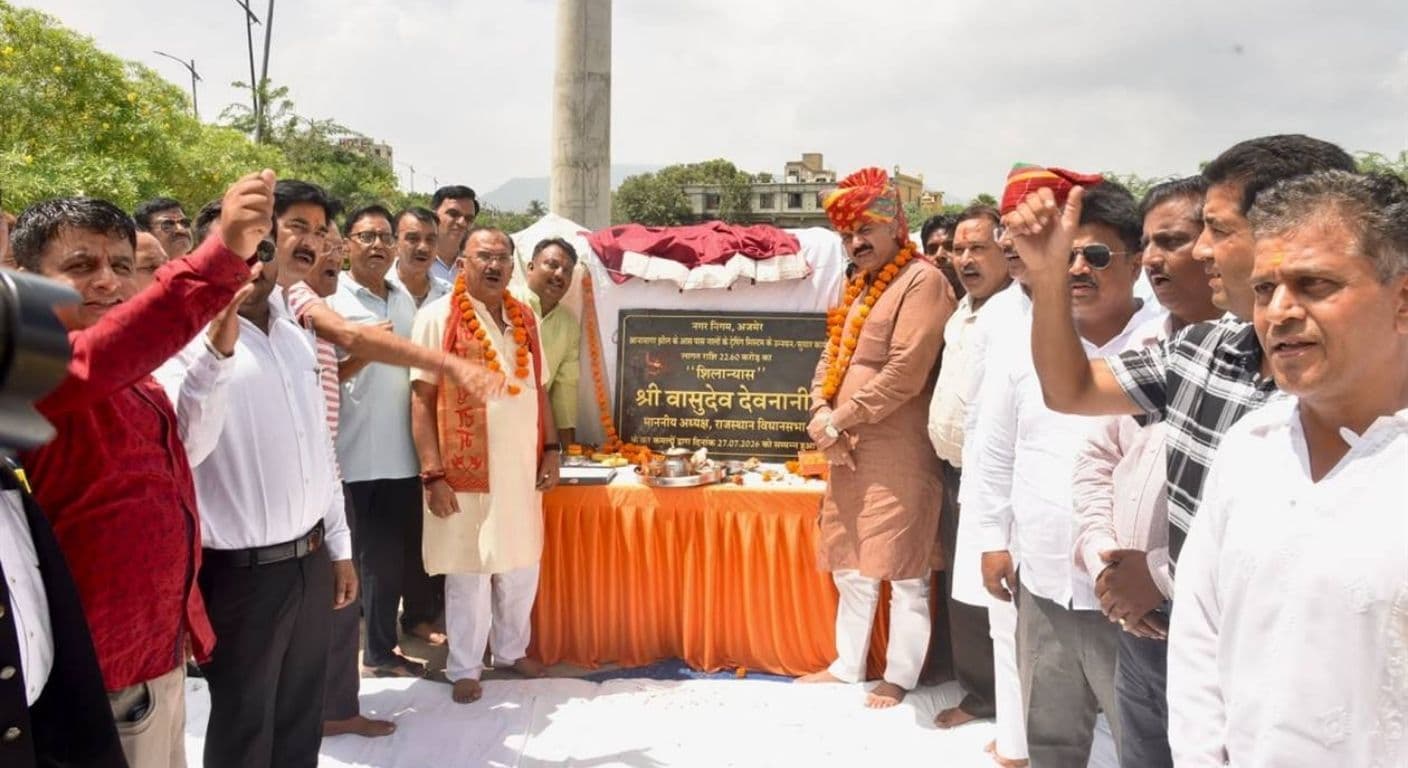
Ajmer has moved ahead with a major lake-cleanup intervention after Assembly Speaker Vasudev Devnani laid the foundation stone on Monday, July 27, 2026 for a Rs 22.60 crore project aimed at stopping sewage-heavy drain water from entering Ana Sagar Lake. The plan, being taken up under AMRUT 2.0, focuses on intercepting drains around the lake and sending their flow into treatment infrastructure instead of letting polluted water keep reaching the water body.
For Jaipur, the project is worth watching as a state-level test of whether Rajasthan can shift from symbolic lake-cleanup announcements to hard utility work such as sewer interception, pumping and treatment capacity. The project is in Ajmer, but the model matters more widely because urban water bodies across Rajasthan face the same mix of stormwater inflow, sewage contamination and long-term maintenance pressure.
Quick Highlights
- Rs 22.60 crore has been earmarked for the Ana Sagar intervention.
- The plan is to connect 14 major drains around the lake to sewer and treatment infrastructure.
- The work includes about 10.68 km of sewer line.
- Sewage from the linked drains is to be routed to a 13 MLD sewage treatment plant.
- An additional 7 MLD STP is also under construction in the same campus.
- Once the system is complete, the plan calls for 20 MLD of treated water per day to be released into the lake.
What the project is designed to do
The core problem is that some drains around Ana Sagar currently carry a mix of rainwater and domestic sewage, which affects the lake's water quality. The new project is meant to intercept that flow before it reaches the lake. Officials have said a work order has already been issued, and a detailed survey for the scheme began on July 16, 2026.
The engineering package goes beyond simply linking open drains to a line. The scope includes drain trapping, a pumping station, mechanical and manual screening, and the new sewer pipeline needed to move the intercepted flow into treatment. That matters because the long-term impact will depend less on the headline budget and more on whether the system works reliably in real monsoon and sewage-load conditions.
| Project item | Current detail |
|---|---|
| Total cost | Rs 22.60 crore |
| Scheme | AMRUT 2.0 |
| Major drains to be linked | 14 |
| New sewer line length | About 10.68 km |
| Primary treatment path | Linked sewage to 13 MLD STP |
| Additional treatment capacity in progress | 7 MLD new STP |
| Backup diversion option | To 60 MLD Khanpura STP if needed |
| Target after completion | 20 MLD treated water daily into the lake |
Why the treatment details matter
The most important operational detail is not the foundation event itself but the treatment chain behind it. The project is designed so intercepted sewage can be treated at the 13 MLD plant, while the additional 7 MLD unit now under construction can strengthen overall handling capacity. There is also a proposed fallback arrangement to divert sewage to the 60 MLD Khanpura STP if the main plant is temporarily unavailable for technical reasons.
That backup planning is notable because lake-cleanup projects often struggle when treatment systems go offline or run below capacity. If the diversion system is actually built and maintained, it could reduce the risk of untreated sewage slipping back into the lake during breakdowns or maintenance periods.
What happens next
The real test now is execution. The state has outlined a technically specific project, but Ajmer residents will judge it by visible results: whether dirty inflows are actually reduced, whether treatment infrastructure performs consistently, and whether Ana Sagar sees measurable improvement over time rather than a one-day ceremonial reset.
If the drain-linking work, treatment integration and backup arrangements are completed as planned, the Ana Sagar project could become one of the more practical urban water-restoration efforts underway in Rajasthan. If execution slips, the story will remain a strong project brief without the cleaner lake outcome it is promising.