
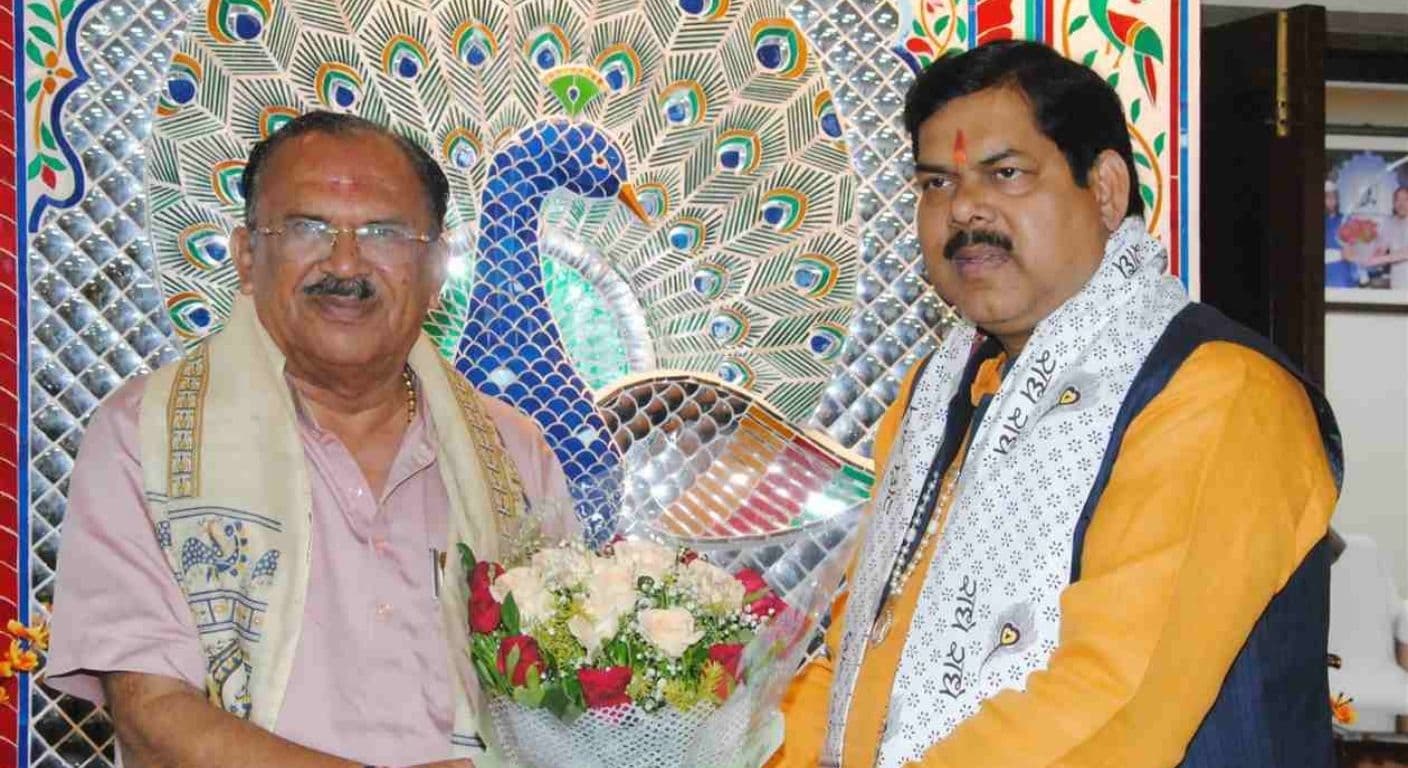
Bihar has signalled interest in borrowing from Rajasthan's education-reform playbook after a policy discussion in Jaipur on July 6, 2026. Bihar Education Minister Mithilesh Tiwari met Rajasthan Assembly Speaker Vasudev Devnani at the Vidhan Sabha, where the two discussed education quality, innovation, the National Education Policy and the exchange of best practices between states.
The meeting carried more weight than a routine courtesy call because Tiwari said Bihar is studying Rajasthan's coaching-regulation approach and the wider reforms Devnani pushed during his 2013 to 2018 tenure as Rajasthan's education minister. For Jaipur readers, that makes the capital not just the venue for a political meeting, but the place where Rajasthan's earlier education-policy model is again being presented as a reference point for another state.
Quick Highlights
- The meeting took place at the Rajasthan Vidhan Sabha in Jaipur.
- The two sides discussed quality education, innovation, the National Education Policy and interstate learning.
- Devnani revisited the reforms introduced during his 2013 to 2018 stint as education minister.
- Tiwari said Bihar is studying Rajasthan's coaching legislation with a view to working on a similar bill.
- Both leaders also discussed holistic student development, value-based education and technology-led teaching.
What Rajasthan's reform model included
Devnani used the meeting to outline the broad logic behind the education changes associated with his earlier tenure: technology, transparency, values and quality were presented as the four main pillars. He argued that education should not be treated only as a route to information, but as the basis for nation-building, character-building and future-building.
The reform list highlighted in the discussion was wide-ranging. It covered administrative systems, student support, curriculum direction and teacher management rather than one single scheme. That helps explain why another state might treat Rajasthan's experience as a full governance template instead of just a set of isolated programmes.
| Reform area | Examples highlighted in the discussion |
|---|---|
| School governance and transparency | Shala Darpan, Shala Darshan, the RTE portal, the private school portal and more transparent administrative systems. |
| Digital learning and student support | Raj e-Gyan portal, scholarship systems, digital literacy, English digital study material, computer training and online scholarships. |
| Access and quality improvements | Free admission, fee reimbursement, school upgradation and the creation of model and excellent schools. |
| Curriculum and staffing | Space for Sanskrit, Indian knowledge traditions, yoga, Surya Namaskar, national icons in the curriculum, transparent teacher counselling and scientific staffing patterns. |
Why Bihar's interest stands out
The most concrete signal from the meeting was Tiwari's statement that Bihar is studying Rajasthan's coaching bill and working toward a similar legislative route. That does not amount to an announced law yet, but it does show Rajasthan's education-policy experience is being treated as something that can be adapted beyond its own borders.
That matters because education reform often gets discussed in broad ideological terms, while the harder question is whether one state can actually use another state's administrative tools. In this case, the conversation moved beyond praise and into the territory of specific policy borrowing, especially on regulation and system design.
More than a one-off political meeting
Tiwari described Devnani as a guiding figure in education reform and said Bihar could use the experience and suggestions shared in Jaipur to make its own education system more effective, more transparent and more quality-focused. The conversation also covered value-based education, holistic student development, Indian knowledge systems and the use of technology in teaching.
The release does not offer a timeline for any Bihar policy move, nor does it spell out which parts of Rajasthan's model are most likely to be copied first. Even so, the Jaipur meeting is notable because it frames Rajasthan's earlier school-sector reforms as a living reference model for other states, rather than a closed chapter from a past administration.