
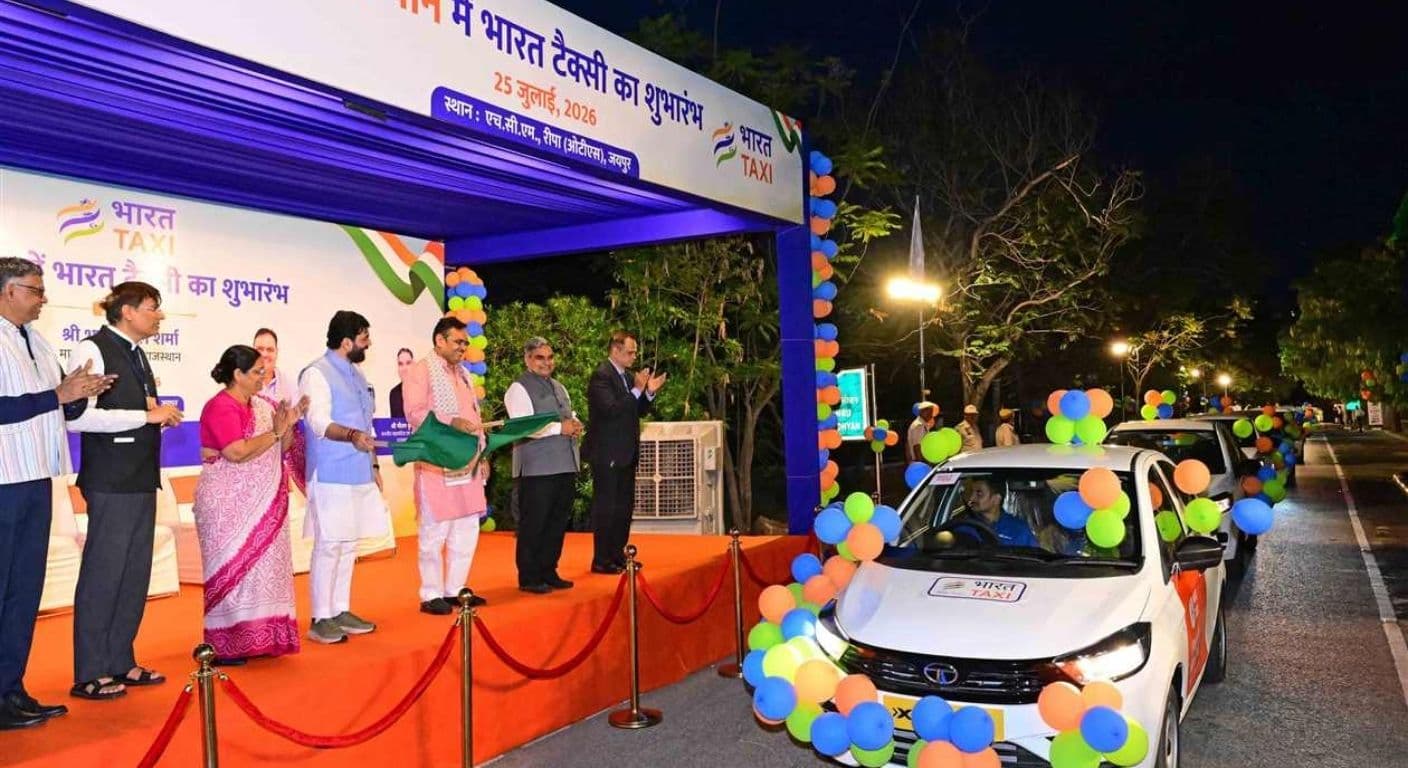
Jaipur has moved from planning Bharat Taxi to formally launching it, with Chief Minister Bhajan Lal Sharma flagging off more than 100 cabs, bikes and autos at HCM RIPA on July 25, 2026. The platform is being positioned as a cooperative mobility service in which drivers are not just operators but stakeholders with an ownership role, a model the government says can expand livelihoods while also widening the city's transport options.
The immediate local significance is that this is not being presented as a small pilot. Officials said the platform has already drawn more than 30,000 drivers and about 7 lakh customers after its Jaipur soft launch. That gives the formal rollout a much bigger scale claim than the city's earlier preview-stage announcement and suggests the service wants to compete seriously in last-mile travel, tourism movement and everyday intra-city trips.
Quick Highlights
- Jaipur formally launched Bharat Taxi on July 25, 2026.
- More than 100 vehicles including cabs, bikes and autos were flagged off.
- Officials said the platform already has 30,000+ drivers and around 7 lakh customers after its Jaipur soft launch.
- The model promises that drivers will work as participants and co-owners, not only service providers.
- The release says drivers will face no extra commission or other deductions on earnings and will get the full benefit of their work.
- An accident insurance cover of up to Rs 5 lakh was also highlighted for drivers.
What the Jaipur rollout includes
The launch was tied to a set of local institutional linkages rather than a generic brand event. During the programme, the cooperative exchanged MoUs with RCDF, Jaipur Municipal Corporation, Jaipur Metro and Rajasthan State Road Transport Corporation. Six drivers were also given share certificates, underlining the ownership language around the platform rather than treating drivers as only app-based contractors.
That local alignment matters because it hints at how the service could try to position itself inside Jaipur's wider movement network. If those partnerships translate into actual operating channels, Bharat Taxi could end up targeting feeder connectivity, official travel demand, tourism movement and city-level mobility services instead of operating only as another stand-alone booking app.
| Launch element | Detail |
|---|---|
| Formal Jaipur launch | July 25, 2026 at HCM RIPA |
| Vehicles flagged off | 100+ cabs, bikes and autos |
| Local MoU partners | RCDF, Jaipur Municipal Corporation, Jaipur Metro and RSRTC |
| Share certificates | 6 drivers were given certificates |
| Soft-launch traction claim | 30,000+ drivers and around 7 lakh customers |
What the driver-owner model promises
The platform's main differentiator is the promise that drivers, described here as sarthis, will have a stake in the system instead of paying their way through opaque commissions or recurring platform-side deductions. The release says drivers will not lose income to extra commission cuts and will get the full benefit of their labour. It also says the structure includes accident insurance of up to Rs 5 lakh, positioning the service as both an income and welfare pitch.
That matters in Jaipur because the city's drivers already work in a crowded mobility market where commissions, subscriptions and platform rules can directly affect take-home income. A cooperative model only becomes meaningful if it really changes those economics on the ground. So the real test will be whether drivers actually see better retention of earnings, clearer account rules and a more durable ownership stake once the service begins operating at scale.
Why the scale claim matters
The launch release goes beyond local ceremony and makes a larger growth claim. It says Bharat Taxi has already connected roughly 8 lakh drivers and 41 lakh customers nationally, while handling about 11,000 trips a day, and that the service is meant to expand to 500 cities. For Jaipur, that suggests this rollout is being framed as part of a national cooperative-mobility network rather than a city-only experiment.
The state government is also linking the service to broader economic and urban themes. The release argues that a city like Jaipur, with its tourism traffic, expanding metro network and growing local transport demand, can give the platform multiple use cases at once. That makes the local question less about launch optics and more about whether Bharat Taxi can convert those policy claims into visible daily ridership and dependable supply.
What to watch next
The next phase to watch is operational, not ceremonial: whether the MoUs create real transport use cases, whether the city-side scale claims hold up, and whether drivers actually receive the no-extra-deduction and insurance benefits that were highlighted at launch. Another important test is whether Jaipur's tourism demand and future metro expansion give the platform an edge in feeder and short-trip travel.
If those pieces start working together, Jaipur could become one of the clearest test cases for whether a cooperative ride-hailing model can grow beyond policy language. If not, the launch will remain notable mainly for its symbolism. Either way, the formal rollout means Bharat Taxi has now moved from a proposed June launch to an on-ground Jaipur operation that will be easier to measure in the months ahead.