
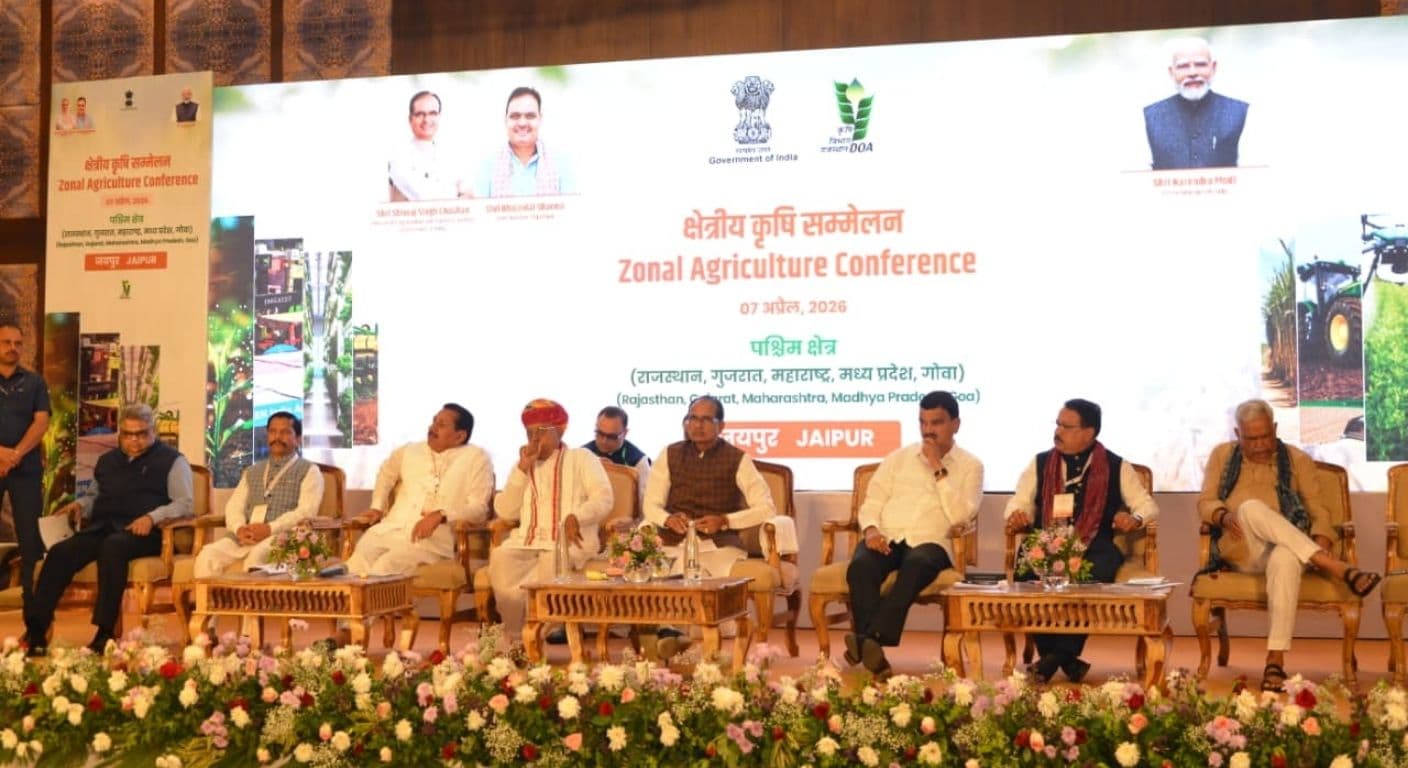
India's farm planning framework could start shifting away from one-size-fits-all seasonal meetings after a regional agriculture conference in Jaipur, set out a plan for state-specific crop roadmaps. Union Agriculture Minister Shivraj Singh Chouhan said the country will be divided into five agro-climatic zones, with crop strategies shaped around each state's climate, soil, water and available resources.
The other major takeaway from Jaipur was the proposed farmer ID rollout. Chouhan said work is moving quickly across states and expressed confidence that a unified identification framework for farmers could be ready in about three months, turning it into the operating base for fertilizer, seed, crop insurance and crop-loss compensation systems.
Quick Highlights
- Jaipur hosted the first regional agriculture conference under the new approach.
- India is to be divided into five agro-climatic zones for separate regional planning.
- Farmer IDs are expected to become the backbone for fertilizer, seed, insurance and compensation delivery.
- The conference said about 16,000 scientists will reach farmers directly through a lab-to-land model.
- For Rajasthan, the conference cited targets including 2,45,000 quintals of pulse seed distribution, 30 dal mills and Rs 312 crore under the pulses mission for 2026-27.
What changes after the Jaipur conference
Until now, much of the national crop discussion was framed through broader kharif and rabi meetings. The new approach is meant to go deeper by grouping the country into five regional clusters and then drawing up state-wise farm roadmaps instead of relying only on high-level seasonal reviews. That could matter for Rajasthan because the state's water stress, cropping patterns and climate risks are very different from those in wetter or more uniform agricultural regions.
The Jaipur meeting brought together scientists, farm experts, FPOs and procurement-linked institutions in one place to shape that shift. If the model holds, the next farm-policy decisions could become more location-specific, including which crops, which varieties and which farming practices are likely to work best in each region.
Why the farmer ID push matters
The farmer ID plan could end up being the more immediate operational change. Chouhan said the system is intended to create a unified identity for farmers so the delivery of fertilizer, seeds, crop insurance and compensation becomes more precise and more transparent. He also linked it to reducing black marketing and improving distribution based on land and crop details rather than broad, less targeted allocation.
That matters because farm support often slows down at the delivery stage even when schemes are already funded. If the ID layer is completed on schedule, it could make it easier to connect benefits directly to growers and speed up support in cases such as crop-loss compensation. The conference also said the framework is meant to include tenant or sharecropping farmers where approval structures allow that support to be extended.
| Rajasthan-linked conference target | Figure discussed in Jaipur |
|---|---|
| Pulse seed distribution target | 2,45,000 quintals |
| New pulse varieties under identification and use | 79 |
| Dal mills targeted in Rajasthan | 30 |
| Pulses mission allocation for 2026-27 | Rs 312 crore |
What the oilseed and pulses push looks like
The conference also tied the roadmap discussion to larger production goals. Officials said oilseed output reached a record 429.89 lakh tonnes in 2024-25, up from 396.69 lakh tonnes in the previous year, while productivity rose from 1314 kg per hectare to 1412 kg per hectare. The longer-term target placed on the table is even larger: oilseed area rising from 29 million hectares to 33 million hectares, and production from 39.2 million metric tonnes to 69.7 million metric tonnes.
For pulses, the emphasis was on stronger seed systems, more processing capacity and firmer support to growers. The conference discussed new seed production incentives, faster movement of new varieties into the seed chain, more dal-mill capacity and full MSP procurement from willing farmers in key pulse crops. For Rajasthan, those numbers are not abstract: the state's seed-distribution target, dal-mill plan and fresh allocation suggest it is expected to play a significant part in the wider pulses push.
Why Jaipur is central to this story
Jaipur was not just the venue. By hosting the first conference under this regional model, the city became the staging ground for a policy reset that could shape how Rajasthan's crop planning, farm support and agri-processing investments are handled in the next phase. The conference also linked that shift to a 16,000-scientist lab-to-land outreach model, which is supposed to carry research and technology directly into farm practice.
The real test now is execution. If the farmer ID timeline holds and the state-specific roadmap model begins influencing actual crop choices, seed supply, insurance delivery and processing investments, the Jaipur conference could end up mattering far beyond a single policy event. If not, it risks becoming just another big agricultural announcement without visible on-ground change.