
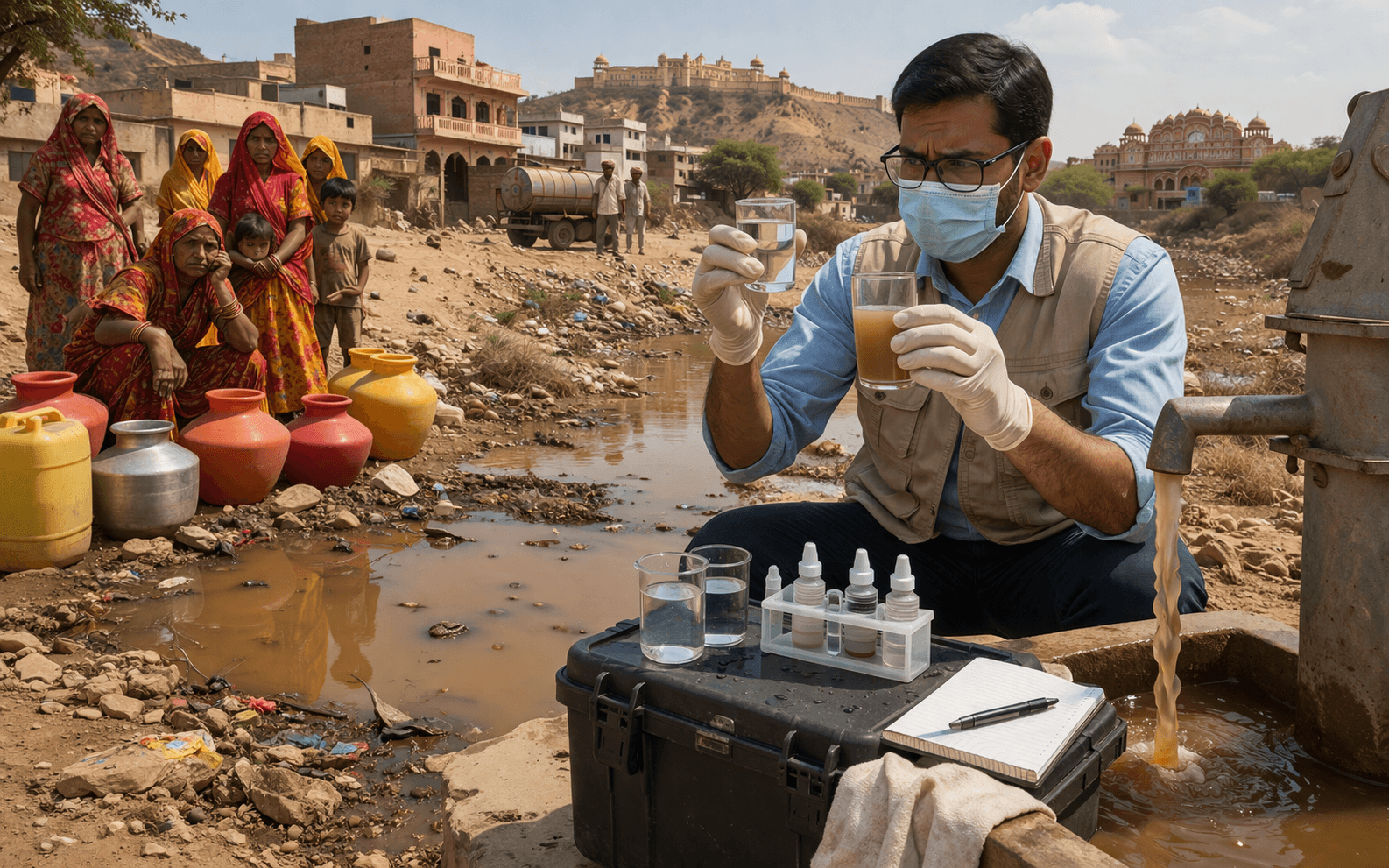
Tap and hand pump water in parts of Jaipur is coming under a sharper safety warning. A Central Ground Water Board aquifer report for Jaipur says Sanganer, Chaksu, Dudu and Phagi are among the district's worst-affected zones, and in Sanganer every third water sample is no longer fit for drinking.
The local alert also sits inside a bigger national pattern. The CGWB's Annual Ground Water Quality Report 2025 says 28.3 percent of groundwater samples across India were outside drinking-water norms, while Rajasthan remains the state most affected by fluoride contamination.
Quick Highlights
- Sanganer, Chaksu, Dudu and Phagi are among Jaipur district's worst-affected groundwater zones.
- In Sanganer, every third tested sample was found unfit for drinking.
- CGWB says 28.3 percent of groundwater samples across India are outside drinking-water norms.
- Rajasthan remains the worst-affected state for fluoride contamination, while nitrate is the biggest national groundwater pollutant.
That combination matters for Jaipur because the city's rapid outward expansion, rising extraction and weak sewage management are putting more pressure on already stressed groundwater systems.
Where Jaipur is taking the biggest hit
The Bhaskar report, citing CGWB's Jaipur aquifer findings, says the worst local impact is visible in Sanganer, Chaksu, Dudu and Phagi. In Sanganer, one out of every three tested water samples was found unfit for drinking, making it one of the clearest red flags in the district.
The report links the deterioration partly to fast-growing colonies on the city's edge, population growth and poor sewage handling. It suggests that the outer belt around Jaipur is seeing the most visible decline in water quality rather than the core city alone.
Why Rajasthan remains highly exposed
Rajasthan's dry geology and rock profile allow more fluoride to dissolve into groundwater, which is why the problem remains persistent across the state. The report also says falling groundwater levels and rising heat are worsening salinity, keeping Rajasthan among the country's most affected regions on groundwater quality.
By contrast, states such as Kerala, Tamil Nadu and Karnataka were described as being in relatively better shape because of stronger rainfall patterns and better water management. That comparison underlines how climate stress and groundwater overuse are combining against Rajasthan.
Nitrate, sewage and runoff are adding to the risk
The report says nitrate is now the single biggest nationwide cause of groundwater pollution, with about 20 percent of samples above the prescribed limit. For drinking water, the safe nitrate limit cited in the report is 45 mg per litre.
It also flags the Jaipur region's wider contamination chain. More than 15 dams lie around the city, and reservoirs such as Nevta, Kanota, Barkheda, Chandalai and Ramchandrapura are said to be receiving sewage and chemical-laden water. That water is then used in agriculture, adding another long-term public-health concern to the groundwater story.
There is one partial relief point: the report says 94.30 percent of groundwater samples are still suitable for irrigation. But for households depending on taps, hand pumps and local borewells, the larger message is harder to ignore: Jaipur's groundwater stress is no longer just about quantity, but about safety too.