
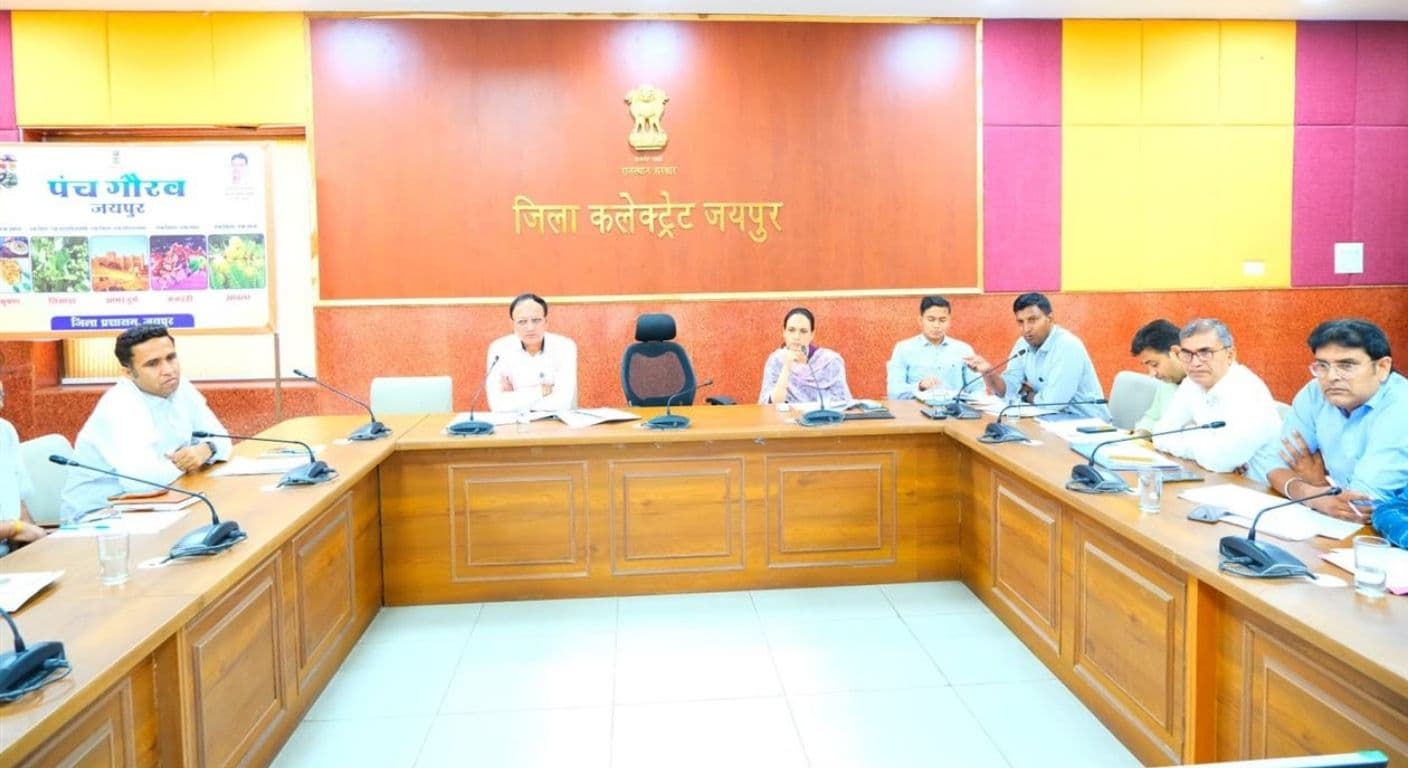
Jaipur's district administration has taken stock of how well budget promises are actually moving on the ground. At a June 23, 2026 review in the Jaipur collectorate, Additional District Collector Jaipur First Rajeev Dwivedi assessed pending budget announcements linked to FY 2024-25, FY 2025-26 and FY 2026-27 and told departments to speed up delayed items.
The review matters because district-level execution is often where budget announcements either turn into visible public works or remain stuck in files. The meeting was less about a new scheme and more about whether previously announced commitments are being finished on time, especially when multiple departments and land-related clearances are involved.
Quick Highlights
- Jaipur reviewed pending budget announcements across three financial years: 2024-25, 2025-26 and 2026-27.
- Departments that finished their assigned announcements within the timeline were praised.
- Officials handling delayed items were told to complete them quickly.
- Projects involving more than one department were flagged for stronger inter-department coordination.
- The review also covered land allotment needed to move pending works into implementation.
What the review focused on
Dwivedi's message was straightforward: announcements are not enough unless departments complete them within the intended time frame. The review separated better-performing departments from those where work is still pending, and the latter were instructed to accelerate delivery.
That makes this meeting a useful governance signal for Jaipur readers. Instead of announcing a fresh package, the district administration is checking whether older commitments are being translated into actual action. In a city where many public works depend on layered approvals, these follow-up reviews often matter more than headline declarations.
| Review area | Direction from the meeting |
|---|---|
| Completed budget announcements | Departments that met the timeline were acknowledged. |
| Pending announcements | Lagging departments were told to finish them quickly. |
| Multi-department projects | Officials were asked to work with stronger coordination where more than one department is involved. |
| Implementation support | Directions were issued on land allotment needed for project execution. |
Why land and coordination matter
The most practical part of the review may be the emphasis on land allotment. Many public projects slow down not because money has been announced, but because the site, transfer process or inter-department approvals are not settled in time. By explicitly reviewing land-related requirements, the district administration signaled that execution bottlenecks are being tracked alongside budget commitments.
The same applies to coordination. Where one announcement touches more than one department, timelines can slip unless departments move together. The meeting's call for joint follow-through suggests the administration is trying to reduce that gap between approval and delivery.
What to watch next
The release does not list the exact number of pending announcements, the sectors involved or revised deadlines for completion, so the next useful checkpoint will be whether departments start closing those pending items over the coming weeks. For Jaipur residents, the test is simple: whether announced works become visible as completed projects rather than remaining under repeated review.
Additional District Collector III Devyani, CPO Dr Sudip Kumawat and other district-level officers attended the meeting, underlining that this was a broad execution review rather than a department-specific exercise. If follow-up meetings begin to name project-wise progress, the story could become more important as a measure of how quickly Jaipur turns budget intent into ground-level delivery.