
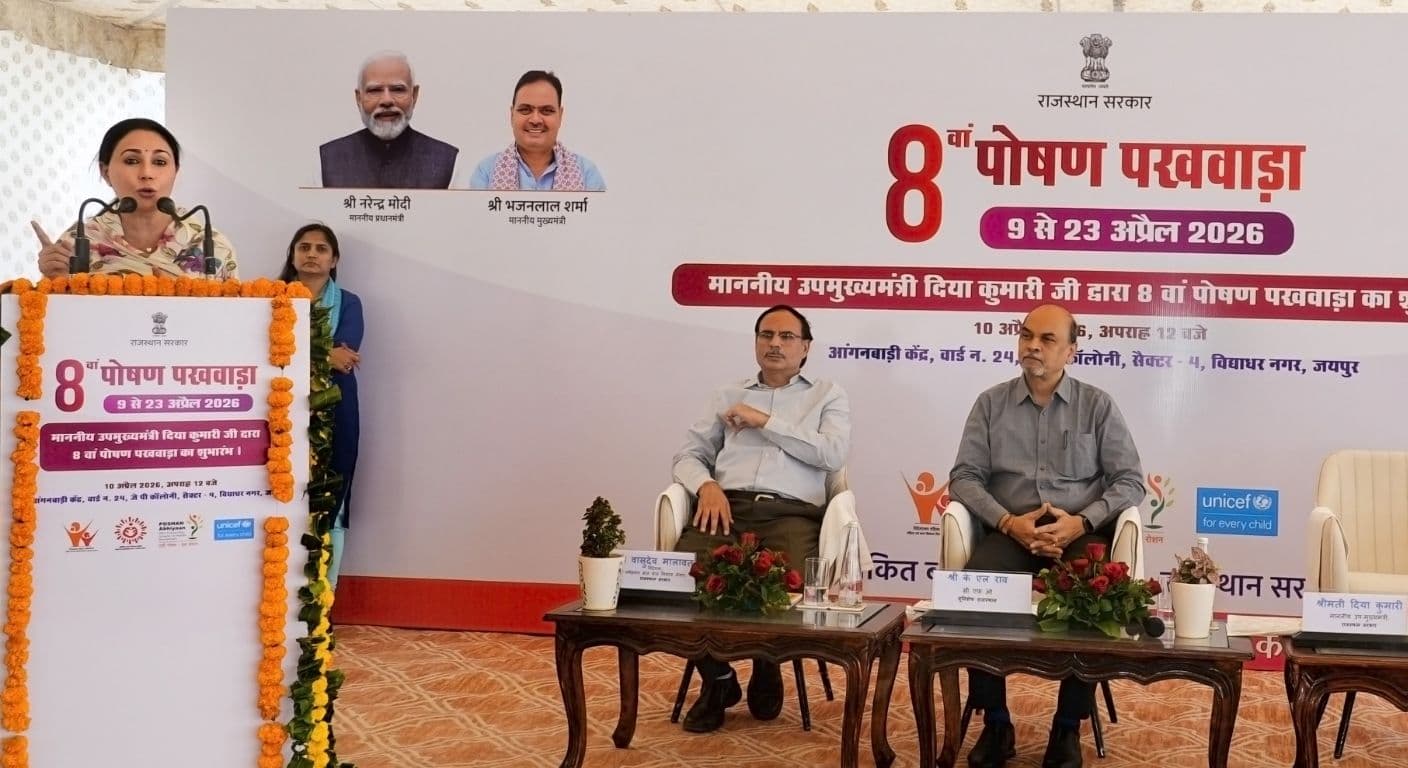
Jaipur's latest child-nutrition push is being tied to a bigger statewide goal: helping Rajasthan repeat its strongest national showing in Poshan Pakhwada. At a programme held at an anganwadi centre in JP Colony, Ward 24, Vidhyadhar Nagar Sector 4, Deputy Chief Minister Diya Kumari said the campaign must keep children's nutrition at the centre of public attention, especially in the crucial years before age six.
The campaign itself runs from April 9 to April 23, 2026 across anganwadi centres, but the Jaipur event made its broader target clear: Rajasthan wants to return to the top of the national nutrition drive after earlier strong showings. For Jaipur readers, that means local anganwadi activity is not just ceremonial outreach. It is being positioned as part of a measurable statewide performance push around nutrition awareness, early care and community participation.
Quick Highlights
- The Eighth Poshan Pakhwada is being observed from April 9 to April 23.
- The Jaipur event was held at an anganwadi centre in Vidhyadhar Nagar Sector 4.
- The campaign focus remains on children up to six years of age.
- Officials said 85 percent of brain development happens by age six.
- Rajasthan had ranked second in National Poshan Maah last September and first in the seventh Poshan Pakhwada.
- More than one lakh activities from Rajasthan were uploaded to the dashboard on the first day of this year's campaign.
Why the first six years matter
The strongest message from the event was simple: the first six years of life shape the long-term future of a child more than any later catch-up effort can. Diya Kumari said those years need the right mix of nutrition, health support and early education, while Women and Child Development Secretary Poonam added that about 85 percent of brain development takes place by the age of six.
That is why anganwadi work matters beyond food distribution alone. The programme linked nutrition with preschool learning, care practices and community participation, arguing that children who receive the right support early will form a stronger generation by the time India reaches 2047. In practical terms, that frames child nutrition not as a welfare side issue but as a long-term public investment.
| Poshan campaign detail | What was highlighted in Jaipur |
|---|---|
| Campaign window | April 9 to April 23, 2026 |
| Target child age group | Children up to 6 years |
| Brain development by age six | About 85% |
| Rajasthan rank in last National Poshan Maah | 2nd |
| Rajasthan rank in seventh Poshan Pakhwada | 1st |
| First-day dashboard activity volume | More than 1 lakh uploads |
Why Rajasthan is chasing another top finish
The ranking target gives this year's campaign a sharper edge. Diya Kumari said Rajasthan should aim to secure first place again, and linked that goal to the work of ICDS teams and anganwadi staff. The release said Rajasthan placed second in National Poshan Maah last September but had finished first in the seventh Poshan Pakhwada, making this year's campaign a bid to restore that lead position.
ICDS Director Vasudev Malavat said more than one lakh activities from Rajasthan were uploaded to the dashboard on the first day alone. That suggests the campaign is being tracked not just through speeches and local events, but through measurable activity reporting across the state.
What happened at the Jaipur event
The Vidhyadhar Nagar programme also included visible public-facing activities meant to turn the campaign into local action. Participants were given a nutrition pledge, a Navchetan Margdarshika was released, a nutrition exhibition was reviewed, and Nutri Bars were distributed to anganwadi children. The event also included an annaprashan activity for infants, underlining the early-life focus of the campaign.
The next thing to watch is whether this awareness drive translates into sustained participation at the anganwadi level through the full April 9 to April 23 campaign window. If it does, Jaipur's local centres could help shape not only Rajasthan's ranking outcome, but also the quality of early childhood support that families actually receive on the ground.