
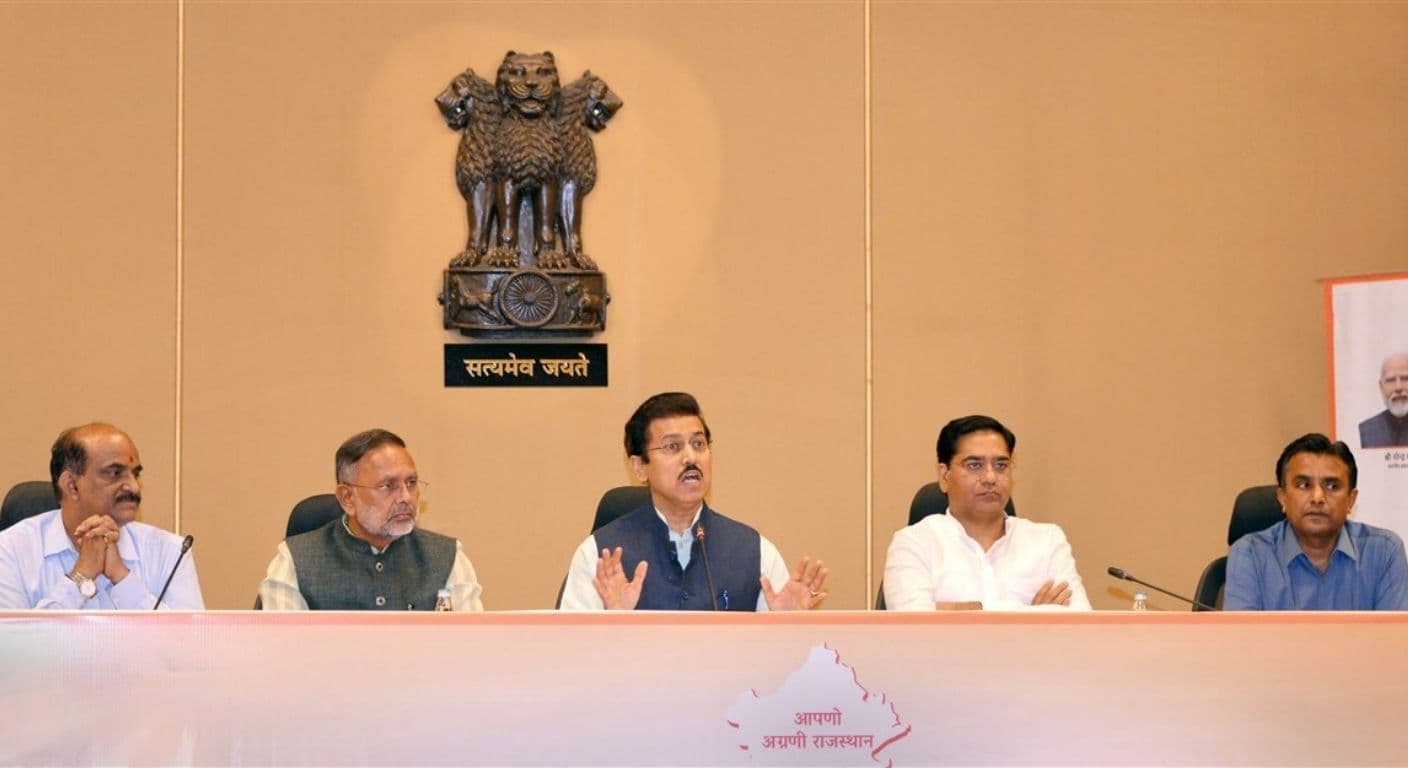
Rajasthan has used a cabinet meeting in Jaipur to clear a new industrial development policy that aims to push the state's economy to 350 billion dollars by 2028-29. The same decision round also included pension-rule easing, a statewide water-conservation drive and additional industrial and renewable-energy land approvals, making it one of the broader policy batches announced from the capital this month.
For Jaipur readers, the significance is direct even when some of the projects are spread across the state. The meeting happened in the chief minister's office in Jaipur, the policy framework will shape investment decisions that affect the capital's industrial and logistics ecosystem, and the citizen-facing measures on pensions, water and power touch everyday governance rather than only long-range economic planning.
Quick Highlights
- Rajasthan cleared a new industrial policy with a stated target of taking the economy to 350 billion dollars by 2028-29.
- The policy promises support for semiconductors, data centres, GCCs and defence manufacturing.
- A Vande Ganga water-conservation campaign will run from May 25, 2026 to June 5, 2026.
- Pensioners will be able to submit annual life certificates through a mobile app with face authentication.
- The state said power demand peaked at 16,487 MW on May 20, 2026, while availability stood at 16,580 MW.
- A Dalmia Cement land-allotment approval is tied to Rs 3,047 crore in estimated investment and about 820 jobs.
What the new industrial policy is trying to do
The industrial policy is the clearest headline decision from the Jaipur meeting because it sets out both a numeric target and a sectoral direction. Officials said the framework rests on four pillars, green industry, governance, growth and globalization, and is meant to move Rajasthan toward a stronger position as a larger manufacturing and investment hub.
The policy is not limited to traditional industries. The state says it wants to promote newer technology-led sectors such as semiconductors, data centres, global capability centres and defence manufacturing, while also giving an extra push to MSMEs, ODOP, exports, gems and jewellery, textiles, tourism, handicrafts, agro-processing, dairy and logistics. It also promises faster approvals, better logistics connectivity, support for CETPs, plug-and-play facilities and node-based industrial parks in the DMIC corridor.
| Cabinet decision area | What was approved or reviewed |
|---|---|
| Industrial policy | New framework targeting a 350 billion dollar economy by 2028-29 |
| Priority sectors | Semiconductors, data centres, GCCs, defence manufacturing plus MSME and export-linked sectors |
| Water campaign | Vande Ganga drive from May 25 to June 5, 2026 |
| Pension changes | Mobile-app life certificate submission and simplified certification rules |
| Power review | Peak demand of 16,487 MW against availability of 16,580 MW |
| Land approvals | Industrial and renewable-energy projects, including a Rs 3,047 crore cement investment proposal |
Which decisions may matter fastest to residents
The most immediate citizen-facing change may be the pension-rule easing. Pensioners are set to get the option of filing their annual life certificate through a mobile app using face-authentication technology, which could reduce repeated office visits for many older users. The state also says permanent-disability documentation for eligible children under pension rules will now need to be submitted only once, and family-pension certification will become simpler.
The water and power decisions are also practical. The Vande Ganga campaign is scheduled to run from May 25, 2026 to June 5, 2026 with water-source cleaning, de-silting, jal chaupals and district-level recognition for strong work. On the power front, the government says supply availability has so far stayed above recorded peak demand in May, and that ministers will regularly review water and electricity delivery while complaints reaching helpline 181 are to be addressed within 24 hours.
What the investment approvals add to the bigger picture
The cabinet batch also included land-allotment approvals that help show how the industrial policy may translate into on-ground investment. The largest named case is for a Dalmia Cement project in Jaisalmer linked to 121.42 hectares of land, an estimated Rs 3,047 crore investment, 3.6 million tonnes of annual cement capacity and roughly 820 jobs. Land was also approved for a proposed railway line tied to J.K. Cement, while renewable-energy land approvals were cleared across parts of Jaisalmer, Barmer and Bikaner.
The next thing to watch is whether the industrial policy quickly develops visible implementation tools rather than staying at the level of intent. For Jaipur, that means keeping an eye on how fast the promised approval reforms, infrastructure support and investor-facing mechanisms translate into real project movement, while the pension, water and power measures provide the nearer-term test of delivery on the citizen-services side.