
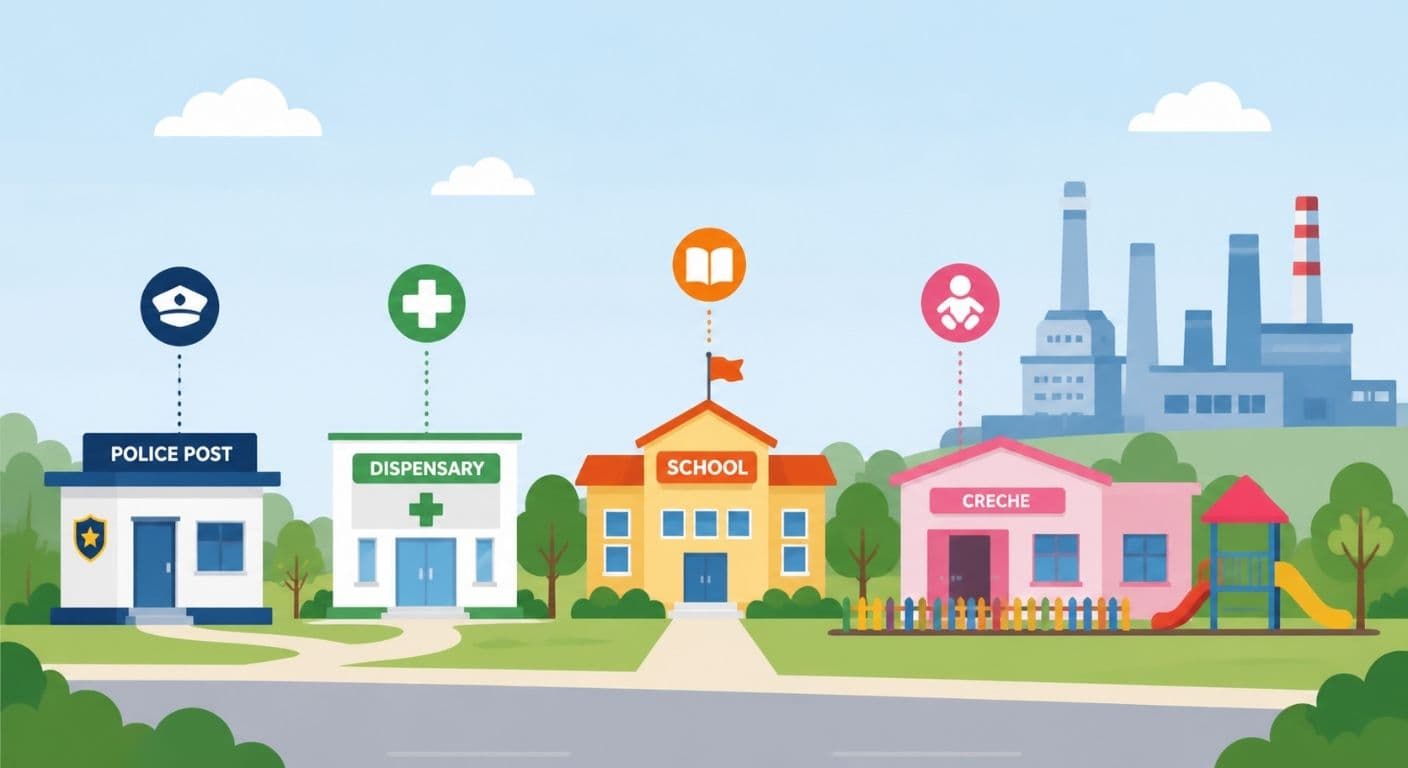
RIICO has changed its land-allotment rules to make it easier to develop public-use facilities inside industrial areas, a move that could bring basic worker services closer to factory zones across Rajasthan. The revised provision is aimed at helping industrial estates get access to facilities such as police posts, ESI dispensaries, primary and community health centres, creches and government schools without forcing workers to depend only on distant urban services.
For Jaipur readers, the update matters because RIICO's policy decisions are shaped from the capital and affect industrial belts linked to Jaipur as well as the wider state network. The change is less about headline industrial investment and more about the day-to-day social infrastructure that makes industrial areas easier and safer to work in.
Quick Highlights
- RIICO has partially amended its Land Disposal Rules, 1979 to simplify land allotment for public facilities in industrial areas.
- Land will be made available free of cost for facilities including police posts, ESI dispensaries, PHCs, CHCs, creches and government schools.
- For police posts, up to 1 acre can be allotted free, with only a Rs 10 one-time economic rent and no service charge.
- Creches can be supported on plots of 250 square metres or more through the Women and Child Development Department or an SPV.
- RIICO will also provide limited free land for a calibration tower and for working and secondary standard labs.
What changes under the new RIICO rule
The policy shift comes through a partial amendment to Rule 3(g) of the RIICO Land Disposal Rules, 1979. In practical terms, it means land allotment for essential public facilities inside industrial areas is being made simpler and, in several cases, effectively free apart from nominal charges.
The state is clearly trying to reduce the gap between industrial growth and worker-facing amenities. Instead of treating industrial land only as a production zone, the revised rule opens more room for services that support health, safety, childcare and schooling near the workplace.
| Facility or use | New provision |
|---|---|
| Police post | Up to 1 acre free; only Rs 10 one-time economic rent; no service charge |
| Government school in service area | Land to be provided free of cost |
| Creche | Free land on plots of 250 sq m or more; routed through the department or an SPV |
| Calibration tower | Up to 500 sq m free for the Industries and Commerce Department |
| Working standard lab | Up to 350 sq m free for the Consumer Affairs Department |
| Secondary standard lab | Up to 660 sq m free for the Consumer Affairs Department |
Why the creche and health provisions stand out
The most practical parts of the reform may be the childcare and health-related provisions. RIICO says creches can now be developed through the Women and Child Development Department or through a special purpose vehicle, provided the industrial area's entrepreneurs or plot allottees are part of that SPV. That creates a route for shared childcare infrastructure inside or near industrial estates rather than leaving working women to manage long-distance arrangements.
Similarly, making room for ESI dispensaries, PHCs and CHCs inside industrial areas could improve access to basic medical support near worksites. For workers, that matters because proximity often determines whether a service is actually usable during the workday.
What this could mean for industrial areas
The broader idea behind the change is that industrial areas should not operate only as clusters of factories and warehouses. They also need the supporting public infrastructure that helps workers, employers and nearby residents function more smoothly. Better access to health, education, security and childcare can make an industrial estate more stable, more attractive for labour and more workable for families.
Additional land beyond the specified free limits will still be allotted at prevailing rates, so the policy is not an open-ended giveaway. Even so, the new rule gives RIICO a more flexible framework to build out social infrastructure alongside industrial activity. The next thing to watch is how quickly these provisions translate into actual dispensaries, schools, creches and support facilities on the ground.