
Market Crisis Deepens as Vegetable Prices Collapse
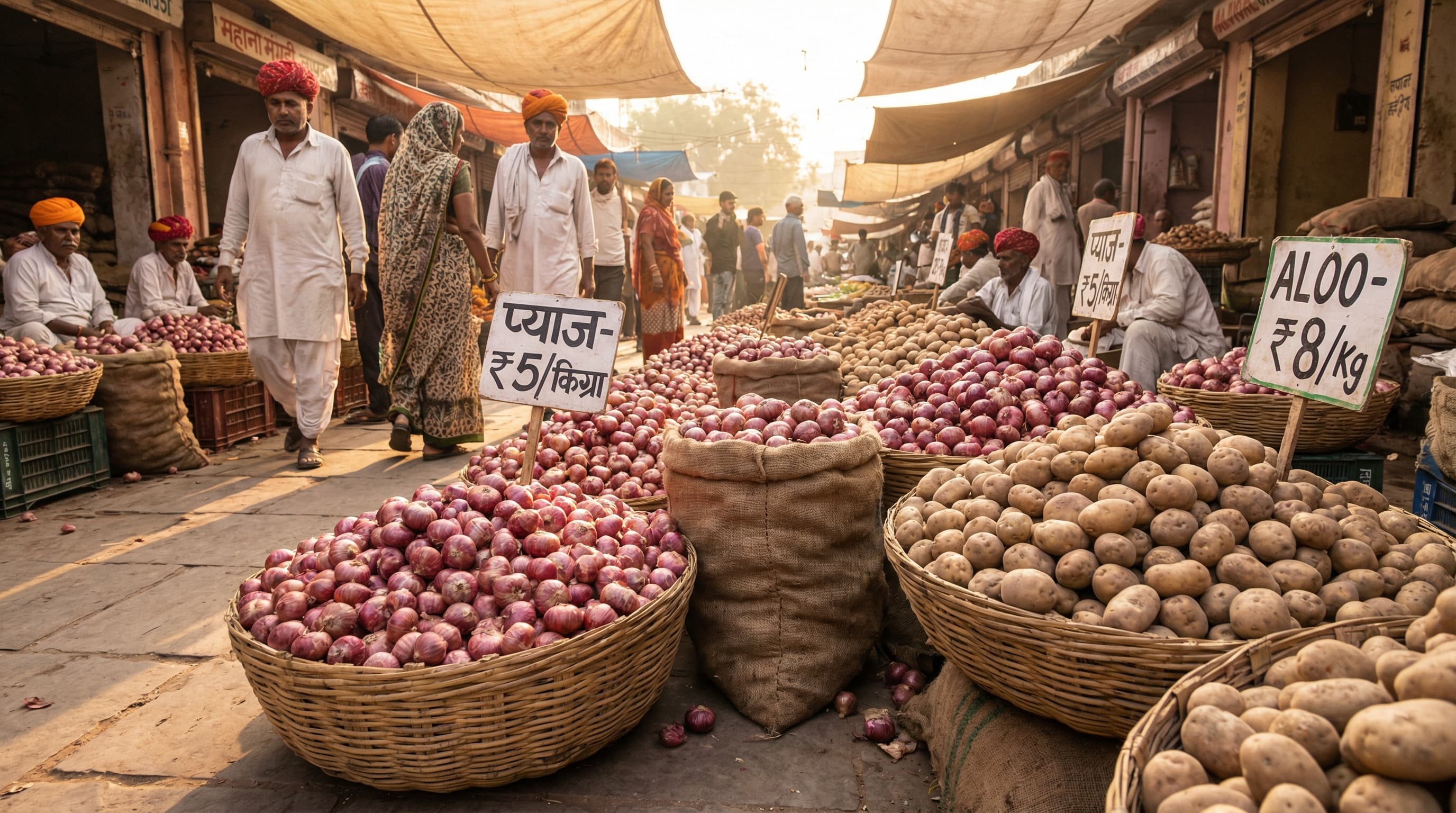
Jaipur's wholesale vegetable markets are witnessing an unprecedented crisis as potato and onion prices have crashed dramatically in November 2025. At the city's bustling Muhana Mandi, farmers and traders are grappling with a perfect storm of oversupply, quality concerns, and plummeting demand that's threatening to waste thousands of tons of produce.
The numbers tell a stark story: Old stock potatoes are selling for just ₹6-9 per kilogram, while onions fetch ₹8-12 per kg – rates that barely cover transportation costs, let alone farming expenses that averaged ₹14-15 per kilogram.
Understanding the Price Collapse
Massive Oversupply Floods Jaipur Markets
The root cause of this crisis lies in sheer volume. Muhana Mandi, Jaipur's primary wholesale vegetable hub, is currently receiving:
- 300-360 trucks of potatoes daily – including 100-110 vehicles carrying old stock from cold storage and 10-15 trucks with fresh harvest
- 400-500 tons of onions every day – comprising 300-400 tons of stored inventory and approximately 100 tons of new crop
This overwhelming supply has created a saturated market where demand simply cannot keep pace with availability. The situation is particularly acute because buyers prefer fresh produce over stored vegetables, leaving farmers with aging stock facing impossible choices.
Export Ban Compounds Domestic Glut
Adding to farmers' woes, the recent halt in exports to Bangladesh has eliminated a crucial outlet for India's vegetable surplus. This neighboring market traditionally absorbed significant quantities of Indian onions and potatoes, but geopolitical and trade policy changes have closed this avenue, forcing all produce into already-saturated domestic markets.
Weather-Related Quality Concerns
Recent rainfall in growing regions has degraded the quality of new onion crops, creating a double-edged problem. While fresh produce typically commands premium prices, weather-damaged vegetables are selling at rates even lower than old stock, creating confusion and uncertainty in pricing structures.
The Human Cost: Farmer Perspectives
Behind the statistics are real people facing financial ruin. One farmer at Muhana Mandi captured the desperation: "Production costs reached ₹14-15 per kilogram, yet current rates are ₹6-7. Either sell at loss or watch produce rot."
This impossible choice reflects a broader crisis in agricultural economics. Farmers who invested in cultivation, labor, irrigation, fertilizers, and pesticides are now unable to recover even their basic costs. The mathematics are brutal:
| Cost Component | Typical Amount (₹/kg) |
|---|---|
| Cultivation (seeds, fertilizer, pesticides) | ₹6-7 |
| Labor and harvesting | ₹3-4 |
| Storage (for old stock) | ₹2-3 |
| Transportation to mandi | ₹1-2 |
| Total Production Cost | ₹14-15 |
| Current Selling Price | ₹6-9 |
| Loss Per Kilogram | ₹5-9 |
The Cold Storage Deadline Adds Urgency
Compounding the crisis is an impending deadline that's forcing farmers' hands. Cold storage facilities across northern India typically shut down their cooling systems by the end of November to prepare for winter operations and maintenance. This creates enormous pressure on farmers to clear old inventory immediately – even at devastating losses.
Storage operators must empty their facilities, which means hundreds of tons of potatoes and onions that have been held in cold storage for months are now hitting markets simultaneously. This flood of old stock, combined with new harvest arrivals, has created the perfect storm of oversupply.
Market Dynamics and Price Trends
Current Wholesale Rates in Jaipur (November 2025)
Potatoes:
- Old stock: ₹6-9 per kg
- Fresh harvest: ₹10-15 per kg
- Quality-degraded stock: ₹5-7 per kg
Onions:
- Old stock: ₹8-12 per kg
- Fresh harvest: ₹12-18 per kg
- Rain-damaged new crop: ₹7-10 per kg
Retail Impact in Jaipur
While farmers suffer, urban consumers in Jaipur are experiencing temporarily lower prices at retail markets. However, this benefit is short-lived and comes at the cost of agricultural sustainability. Retail prices have dropped approximately 30-40% compared to October 2025, with neighborhood vegetable vendors offering:
- Potatoes: ₹15-20 per kg (retail)
- Onions: ₹20-25 per kg (retail)
Broader Economic Implications
Impact on Rajasthan's Agricultural Economy
Rajasthan is a significant producer of both vegetables, particularly in regions around Jaipur, Alwar, and Bharatpur. When prices collapse at this scale, the ripple effects extend far beyond individual farmers:
- Rural purchasing power declines: When farmers lose money, they reduce spending in rural economies, affecting local shops, service providers, and small businesses
- Banking sector stress: Many farmers take loans for cultivation; crop failures and price crashes increase non-performing assets for rural banks
- Future planting decisions: Severe losses in one season can discourage farmers from planting these crops next year, potentially creating future shortages
- Migration pressures: Agricultural distress often pushes rural families toward urban areas in search of alternative livelihoods
The Storage and Processing Gap
India's chronic lack of cold storage infrastructure and food processing facilities becomes painfully apparent during glut situations. While developed agricultural economies can absorb surplus through:
- Advanced cold storage networks
- Food processing industries (chips, dehydrated products, frozen vegetables)
- Export infrastructure with diversified international markets
- Government procurement and buffer stock systems
Indian farmers, particularly in states like Rajasthan, often have limited access to these market stabilizers. The result: produce either sells at whatever price the market offers, or it goes to waste.
Government Response and Policy Questions
The current crisis raises important questions about agricultural policy and market intervention:
Price Support Mechanisms
Unlike wheat and rice, which enjoy Minimum Support Price (MSP) guarantees, vegetables remain largely at the mercy of market forces. While this allows for market-driven efficiency, it also exposes farmers to extreme price volatility without safety nets.
Export-Import Policy Challenges
The recent export restrictions to Bangladesh, while potentially driven by domestic supply concerns or diplomatic factors, have eliminated market outlets without creating alternative demand absorption mechanisms. This highlights the need for more stable, predictable trade policies that farmers can plan around.
Infrastructure Investment Needs
State and central governments face pressure to invest in:
- Modern cold storage facilities with better distribution
- Food processing industries in agricultural regions
- Market linkages connecting farmers directly to institutional buyers
- Crop insurance mechanisms that cover price crashes, not just yield failures
What Happens Next: Short and Long-Term Outlook
Immediate Future (December 2025 - January 2026)
Market observers expect the glut to ease somewhat as:
- Old stock gets cleared (sold or wasted) by early December
- Fresh harvest supplies stabilize after initial flood
- Winter demand for storage-friendly vegetables increases
- Rabi season vegetables provide alternative market options
However, farmers who suffered losses in November will face months of financial recovery, with implications for their next planting season.
Long-Term Structural Issues
Without addressing fundamental problems, similar crises will recur:
- Market information gaps: Farmers often lack real-time data on prices and demand when making planting decisions
- Coordination failures: Individual farming decisions, when aggregated, create boom-bust cycles
- Climate vulnerability: Unexpected rainfall and weather events increasingly disrupt production and quality
- Supply chain inefficiencies: Multiple middlemen between farmers and consumers eat into margins while adding little value
Consumer Perspective: Understanding the Full Picture
While Jaipur residents might welcome lower vegetable prices in neighborhood markets, sustainable food systems require fair prices for producers. When farmers consistently lose money, they:
- Reduce investments in quality inputs
- Switch to other crops (potentially creating future shortages)
- Leave farming altogether
This eventually leads to supply disruptions, import dependencies, and price spikes that hurt consumers far more than temporary gluts help them.
Lessons from This Crisis
For Policymakers
- Vegetable crops need better price stabilization mechanisms
- Export policies should balance domestic needs with farmer incomes
- Infrastructure investment must prioritize storage and processing
- Real-time market intelligence should be accessible to farmers
For Farmers
- Diversification across multiple crops reduces risk
- Farmer producer organizations can provide better market negotiating power
- Staggered planting can help avoid glut situations
- Direct marketing channels may offer better price realization
For Agricultural Researchers
- Develop varieties with longer shelf life and better storage characteristics
- Create forecasting tools to predict price movements
- Research climate-resilient cultivation practices
- Study successful value chain models from other regions
Conclusion: A Crisis That Demands Comprehensive Solutions
The potato and onion price crash at Jaipur's Muhana Mandi is more than a temporary market fluctuation – it's a symptom of deeper structural issues in India's agricultural economy. As farmers watch their produce sell for less than production costs or go to waste entirely, the urgent need for comprehensive solutions becomes clear.
Sustainable agriculture requires fair prices for farmers, affordable food for consumers, and resilient systems that can handle natural supply variations without creating devastating losses or wasteful surpluses. The current crisis in Jaipur's vegetable markets underscores that India still has significant work to do in building such systems.
For now, thousands of farmers in and around Jaipur face the immediate choice between selling at severe losses or letting their hard-earned produce rot. It's a choice no farmer should have to make – and one that demands urgent attention from policymakers, traders, processors, and society at large.
Frequently Asked Questions (FAQs)
Why have potato and onion prices crashed in Jaipur?
Prices have crashed due to oversupply caused by bumper harvests, combined with reduced demand for old stock, halted exports to Bangladesh, and weather-related quality issues. Muhana Mandi is receiving 300-360 trucks of potatoes and 400-500 tons of onions daily, flooding the market.
How much are farmers losing per kilogram?
Farmers are losing ₹5-9 per kilogram on average. Production costs are ₹14-15/kg, but current selling prices are only ₹6-9/kg for old stock and ₹10-15/kg for fresh harvest.
Will vegetable prices remain low for consumers?
No, these are temporary price drops due to a glut situation. Once old stock clears and supply stabilizes, prices will likely return to normal levels. Long-term sustainable food systems require fair prices for both farmers and consumers.
Why don't farmers just store their produce until prices improve?
Cold storage facilities shut down by end of November, forcing farmers to clear inventory. Additionally, storage costs money, and there's no guarantee prices will improve soon. Many small farmers cannot afford extended storage costs.
What can be done to prevent such price crashes in the future?
Solutions include: better cold storage infrastructure, food processing industries to absorb surplus, price support mechanisms for vegetables similar to grain crops, stable export policies, and real-time market information systems to help farmers make informed planting decisions.
Is this problem unique to Jaipur?
No, similar price crashes are occurring in wholesale markets across northern India, particularly in regions where new harvests coincide with old stock clearing from cold storage. However, Jaipur's Muhana Mandi is one of the largest affected markets in Rajasthan.
Note: This article is based on market data and reports from November 2025. Vegetable prices are highly volatile and may change rapidly. For current rates, please check with local mandis or reliable agricultural price reporting services.