
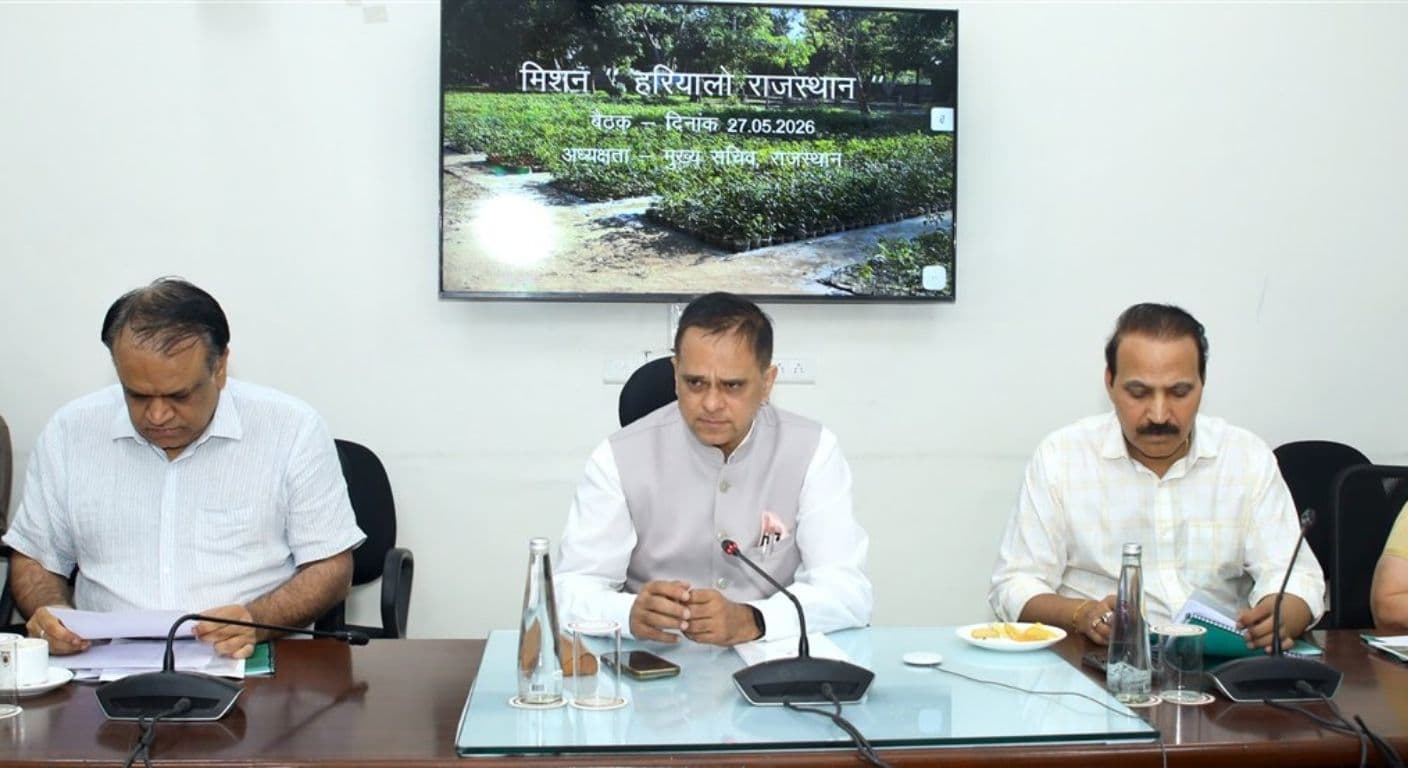
Rajasthan has moved from target-setting to tighter execution for its 2026 monsoon plantation campaign, making geo-tagging and live-photo uploads mandatory for saplings planted under Mission Hariyalo Rajasthan. At a review meeting in Jaipur, the state also said 29 departments had submitted a combined plantation action plan covering about 10.81 crore saplings.
For Jaipur readers, the city is mainly the administrative venue rather than the field focus. The bigger story is statewide: Rajasthan is now trying to prove not just how many saplings can be planted, but how many can be tracked, verified and kept alive after plantation.
Quick Highlights
- Rajasthan is working with a 10 crore plantation target for the 2026 monsoon.
- 29 departments have submitted a combined plantation plan for about 10.81 crore saplings.
- The state has made geo-tagging and live-photo uploads through the Hariyalo app mandatory.
- Officials have been told to ensure the survival of previously planted saplings, not just fresh plantation numbers.
- Industrial areas have also been flagged for plantation priority.
What is new in this review
The headline number is familiar: Rajasthan is again working around a 10 crore plantation goal for the coming monsoon. What is new in this update is the stronger monitoring layer. The state now wants departments to use the Hariyalo app for geo-tagging planted saplings and uploading live photos, while the web portal and mobile app are expected to support more regular monitoring.
That shift matters because plantation drives are often judged by headline totals alone. This review pushed departments to think beyond planting day and focus on whether saplings can actually be traced and kept alive over time.
| Campaign element | Current 2026 position |
|---|---|
| Official monsoon target | 10 crore saplings |
| Departmental action plans submitted | 10.81 crore saplings across 29 departments |
| Monitoring method | Geo-tagging and live-photo uploads through the Hariyalo app |
| Operational focus | Plantation plus protection, verification and sapling survival |
| Priority expansion area | Industrial zones alongside broader statewide planting |
Why the survival check matters
The review also put unusual emphasis on the survival rate of older plantations. Officials were asked to ensure that saplings planted in earlier years remain alive and are properly verified, instead of treating each monsoon cycle as a fresh standalone number game.
That is an important shift in tone. Rajasthan says it planted about 7.22 crore saplings in 2024 and more than 11.75 crore in 2025. Those are large numbers, but the credibility of the mission now depends more on survival, follow-up care and verification than on one more ambitious plantation headline.
How this fits the larger Mission Hariyalo push
The state wants the plantation programme to function as a broader public campaign rather than a forest-department-only exercise. This review reiterated that approach while also widening the focus to places such as industrial areas, where officials now want plantation work prioritised as part of the wider greening effort.
The immediate question for Rajasthan is execution. With departmental plans already adding up to 10.81 crore against a 10 crore target, the real test is no longer whether the target looks achievable on paper. It is whether the state can use digital tracking, inter-department coordination and better protection measures to turn plantation counts into verifiable long-term green cover.