
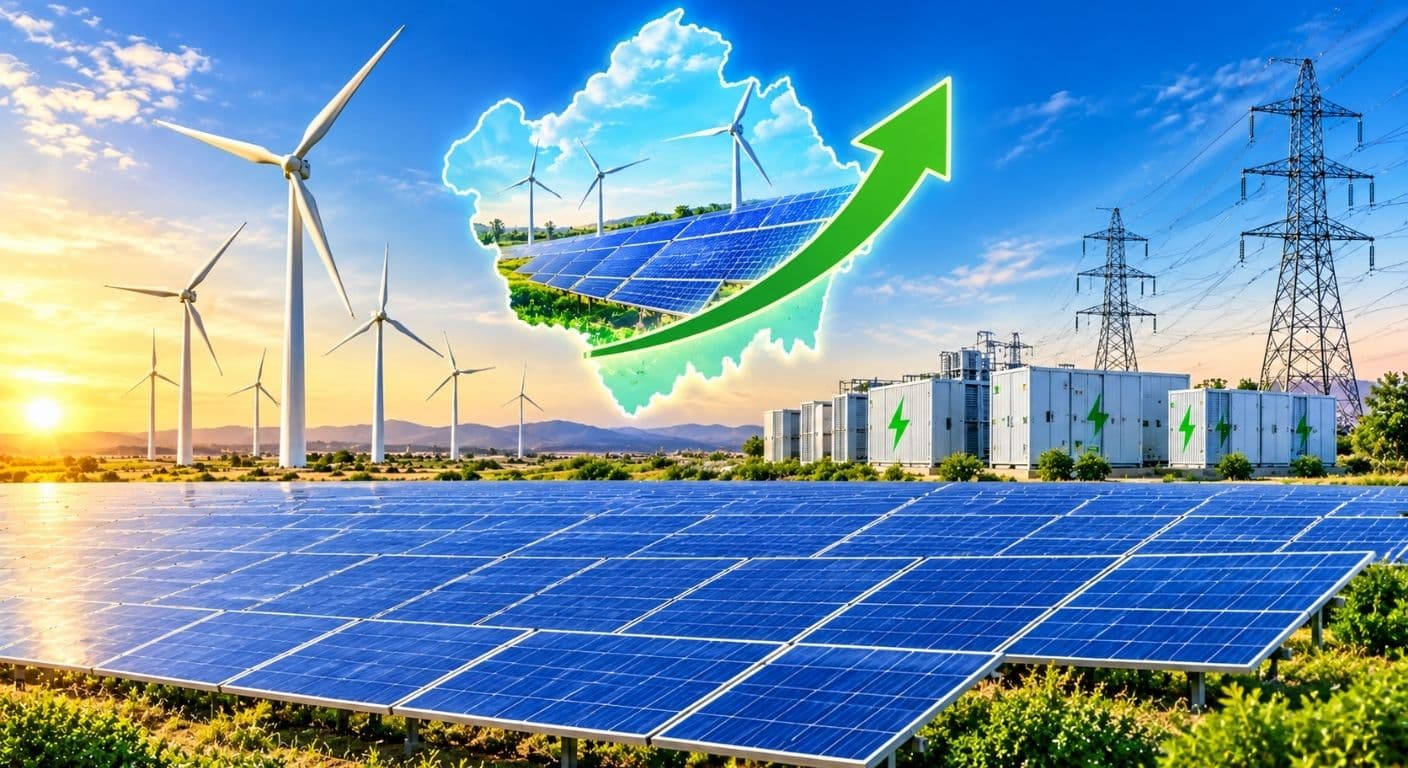
Rajasthan says it has crossed the 50,000 MW mark in installed renewable energy capacity, a milestone that places it second in the country after Gujarat and strengthens its position in India's clean-power transition. In a release issued on Thursday, August 13, 2026, the state said the jump has been driven mainly by solar power and backed by a wider push that now stretches from utility-scale generation to rooftop systems and battery storage.
For Jaipur, the significance is broader than a headline number. This is a statewide signal about how Rajasthan wants to build its future power economy: more solar, more decentralised generation, more storage capacity and a larger long-term investment pipeline. That matters because energy policy increasingly shapes industry, urban growth, household solar adoption and the reliability of supply across the state.
Quick Highlights
- Rajasthan says its installed renewable energy capacity has crossed 50,000 MW.
- The state says it is the second in India after Gujarat to cross the 50 GW mark.
- Solar power leads the mix at 44,135 MW, with the state claiming about 27 percent of India's installed solar capacity.
- The state has set a 125 GW renewable energy target by 2030 under its Integrated Clean Energy Policy 2024.
- Rajasthan says it added 26,552 MW of renewable capacity in roughly the last two and a half years.
- Officials also highlighted rooftop solar, farm-linked decentralised solar and battery storage as the next major growth tracks.
What the 50,000 MW mark includes
The milestone is heavily tilted toward solar, which remains the core of Rajasthan's clean-energy story. The state says it now has 44,135 MW of solar capacity, far ahead of the other components in its installed mix. Wind contributes 5,541 MW, while biomass and waste-to-energy account for 223 MW and hydro projects add another 436 MW.
That composition matters because it shows both strength and dependency. Rajasthan has become a dominant solar state, but the next phase of growth will depend on whether storage, grid balancing and diversified renewable systems can keep pace with the sheer scale of solar addition.
| Renewable component | Installed capacity cited by the state |
|---|---|
| Solar | 44,135 MW |
| Wind | 5,541 MW |
| Biomass and waste-to-energy | 223 MW |
| Hydro | 436 MW |
| Total renewable capacity | 50,000 MW plus |
Why the 2030 target matters
The bigger signal in the release is where Rajasthan wants to go next. The state has linked this milestone to its Integrated Clean Energy Policy 2024, which sets a goal of 125 GW by 2030. That target points to a much larger expansion still ahead, including more solar, wind, hybrid projects and energy-storage capacity.
Officials say Rajasthan added 26,552 MW of renewable capacity in about the last two and a half years, with more than 25,000 MW of that coming from solar alone. That pace helps explain why the 50 GW mark has come so quickly, but it also raises the practical question of how the state will manage transmission, balancing and storage as installations keep accelerating.
Rooftop solar and storage are now central to the story
The release makes clear that Rajasthan is not relying only on giant ground-mounted projects. It says around 5,000 MW of decentralised solar capacity has already been installed under PM Kusum Component A and C, a model tied closely to agriculture and daytime power supply. It also says more than 2.9 lakh rooftop solar systems have been installed under the PM Surya Ghar scheme, linking over 3 lakh families and adding 1,128 MW of capacity.
That is important for cities like Jaipur because rooftop adoption and distributed systems bring the clean-energy transition closer to households, local institutions and everyday electricity use. The release also says state entities are working on battery energy storage projects totalling 12,400 MWh, while discoms are moving ahead on a 172 MW and 688 MWh pilot. In other words, the state is beginning to treat storage not as a side issue but as part of the core clean-power buildout.
What happens next
Crossing 50,000 MW is a symbolic achievement, but the more important test lies ahead. Rajasthan now has to show that rapid capacity growth can be matched with strong storage systems, infrastructure planning and practical consumer-side adoption.
If the next stage holds, the state could deepen its role as one of India's main clean-energy centres. If it does not, the gap between installed numbers and usable system strength will become harder to ignore. For now, the latest milestone shows that Rajasthan's energy strategy is moving beyond headline solar capacity toward a much larger contest over how the state's power future will be built.