
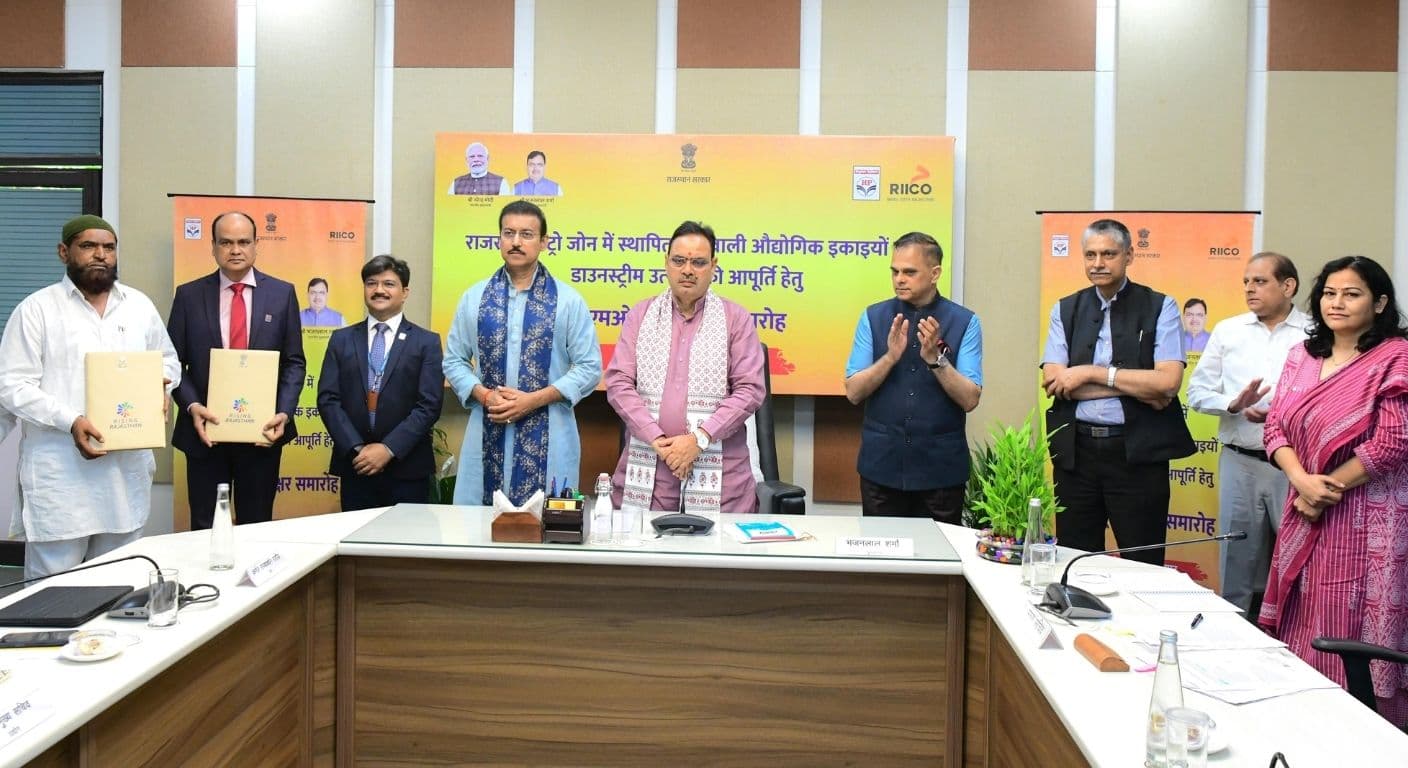
Rajasthan has signed 18 tripartite MoUs to support downstream industrial units in the Rajasthan Petro Zone near the Pachpadra refinery, marking one of the clearest signs yet that the state wants to convert the refinery project into a wider manufacturing ecosystem. The agreements were signed in Jaipur among HPCL Refinery, the state's industries and commerce department, and industrial units that plan to use refinery-linked inputs.
The timing matters. The state says Prime Minister Narendra Modi is scheduled to inaugurate the refinery. That gives the MoUs a practical context: Rajasthan is not only talking about refining capacity, but also preparing the industries that can consume the downstream output once the complex becomes operational.
Quick Highlights
- 18 tripartite MoUs were signed for downstream industrial supply in the Rajasthan Petro Zone.
- The petro zone near the refinery is being developed over 1,022 hectares.
- In phase one, 45 of 86 industrial plots have already been allotted.
- 8 plug-and-play factory sheds have been built for faster startup by investors.
- Phase two will open 257 plots across 213 hectares, with environmental clearance already in place.
- Infrastructure works worth Rs 68 crore have been approved over about 87 hectares.
What the MoUs are meant to unlock
The core idea behind the agreements is straightforward: industries in the petro zone should be able to source raw material directly from the refinery instead of depending on longer and costlier supply chains. That matters because input access often decides whether a manufacturing cluster grows quickly or remains mostly speculative.
The release says the downstream opportunity spans plastics, pharma and automobile components. It also lists key feedstocks such as polypropylene, polyethylene, benzene, toluene and butadiene. Those inputs can support products ranging from packaging films, plastic furniture and farm pipes to auto dashboards, medical syringes and industrial chemicals. In other words, the state is trying to build a value-added manufacturing layer around the refinery rather than limiting it to fuel production alone.
How the petro zone rollout looks right now
The land pipeline shows that Rajasthan is planning beyond a symbolic launch. The first phase has already moved into visible preparation, while the second and third phases are being lined up with plot inventory and environmental approvals.
| Rollout stage | Current position |
|---|---|
| Overall Rajasthan Petro Zone | 1,022 hectares planned near the refinery |
| Phase 1 | About 30 hectares developed; 45 of 86 plots allotted |
| Plug-and-play setup | 8 factory sheds built for faster investor startup |
| Phase 2 | 213 hectares with 257 plots available for allotment |
| Large-format plots | 8 plots planned, ranging from 500 to 162,000 sq m |
| Approved infrastructure works | Rs 68 crore over about 87 hectares |
| Phase 3 | About 780 hectares planned; clearance process underway for 447 hectares |
That rollout is important because it suggests the state is trying to solve both land availability and startup speed together. Plot allotments, plug-and-play sheds and approved base infrastructure all point to an effort to reduce the gap between investment announcements and actual production.
Why this matters beyond the refinery site
For Jaipur readers, this story is about more than a project in Balotra. It is a test of whether Rajasthan can use a large industrial asset to create a broader manufacturing network with jobs, supplier ecosystems and value-added production inside the state. If the petro zone fills up with functioning units, the refinery could anchor a much wider industrial corridor rather than operate as a standalone complex.
The next milestone is not another announcement but execution after the refinery launch. Investors will watch whether plot allotments translate into installed machinery, whether plug-and-play units become operational quickly, and whether downstream product supply remains reliable enough to make the zone commercially attractive. If those pieces move together after April 21, 2026, Rajasthan could gain one of its most important new industrial growth stories in years.