
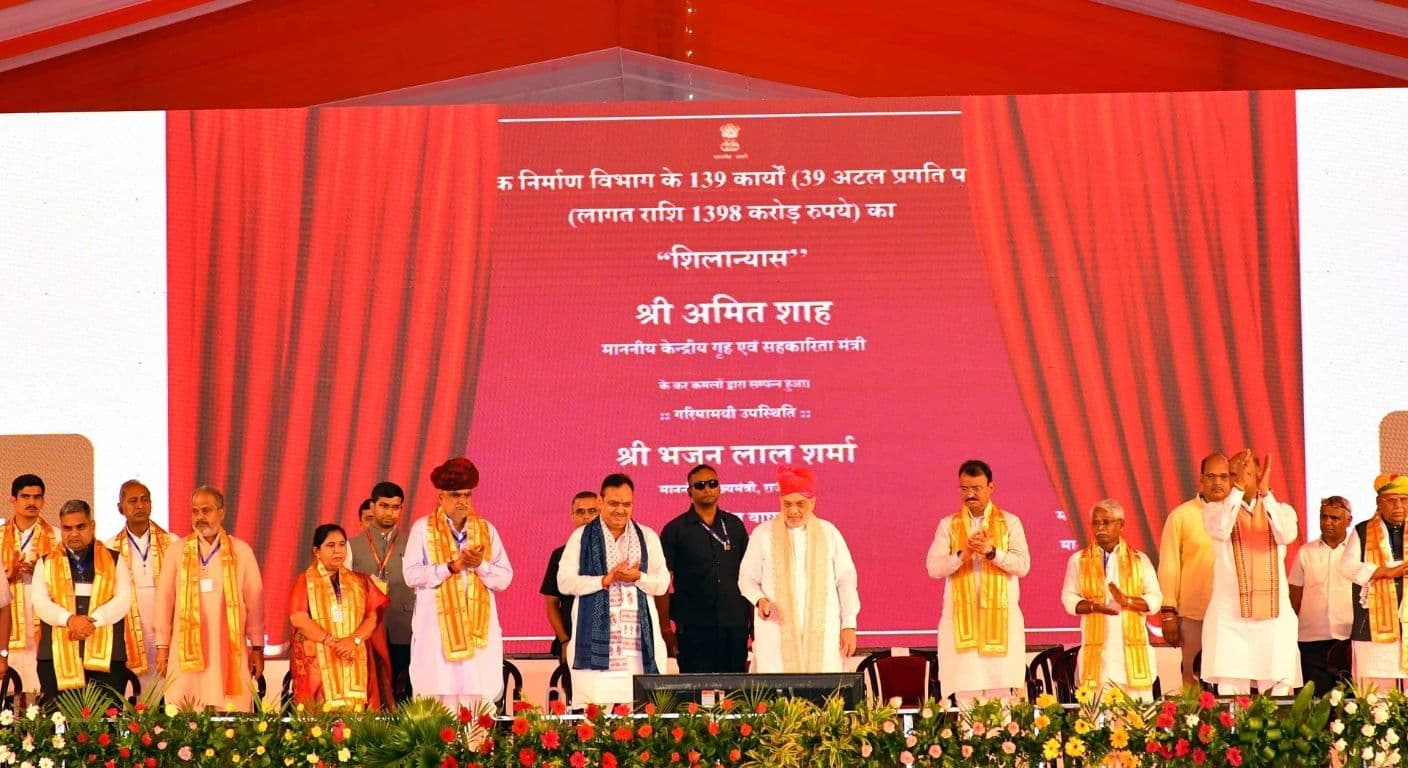
Rajasthan on Sunday, August 16, 2026 announced a large district-level development package tied to 944 works worth Rs 5,659 crore, while also saying that 1,500 villages had been added to household tap-water coverage under the Jal Jeevan Mission. The numbers were presented at a public programme in Nimbahera, Chittorgarh, where an Atal Bihari Vajpayee memorial event was also held.
For Jaipur readers, the most useful takeaway is not the ceremony itself but the scale and spread of the package. The announcement bundles water delivery, district works and broader infrastructure claims into one statewide message about how Rajasthan wants development to look on the ground over the next phase.
Quick Highlights
- Rajasthan says 944 development works worth Rs 5,659 crore were inaugurated or taken up across 15 districts.
- The state says 1,500 villages were newly covered with household tap-water supply under the Jal Jeevan Mission.
- Officials said drinking-water pipeline coverage in Rajasthan has risen from 11 lakh households earlier to 64 lakh households over the last eight years.
- The largest district packages cited in the announcement were in Jodhpur and Banswara.
- The programme took place in Nimbahera, Chittorgarh, alongside the unveiling of an Atal Bihari Vajpayee statue.
How the district package breaks down
The project list spans western, southern and tribal districts, with the biggest financial outlays concentrated in a handful of regions. Jodhpur leads the package at more than Rs 1,475 crore across 96 works, followed by Banswara with more than Rs 1,098 crore across 43 works. Other large allocations mentioned in the programme include Barmer, Kota, Phalodi and Pali.
| District | Works cited | Value cited |
|---|---|---|
| Jodhpur | 96 | More than Rs 1,475 crore |
| Banswara | 43 | More than Rs 1,098 crore |
| Barmer | 65 | More than Rs 477 crore |
| Kota | 29 | More than Rs 455 crore |
| Phalodi | 49 | More than Rs 362 crore |
| Pali | 54 | More than Rs 346 crore |
| Chittorgarh | 136 | More than Rs 328 crore |
| Pratapgarh | 42 | More than Rs 292 crore |
| Jalore | 108 | More than Rs 237 crore |
| Jaisalmer | 63 | More than Rs 202 crore |
| Balotra | 159 | More than Rs 194 crore |
| Salumber | 34 | More than Rs 86 crore |
| Dungarpur | 37 | More than Rs 55 crore |
| Sirohi | 19 | More than Rs 35 crore |
| Bundi | 10 | More than Rs 10 crore |
The spread matters because this was not framed as a single-city or single-sector announcement. It was presented as a multi-district push with roads, civic works and service-delivery projects bundled together under one political and administrative event.
Why the water number matters more than the speeches
The most practical figure in the announcement is the addition of 1,500 villages to tap-water coverage. Officials also said Rajasthan has moved from around 11 lakh household drinking-water pipeline connections earlier to 64 lakh households in eight years under the Jal Jeevan Mission.
That claim deserves attention because water access is one of the few parts of the event that directly affects daily life at scale. Unlike ceremonial messaging, household tap-water expansion is measurable, local and tied to the state's long-running effort to reduce dependence on manual water collection and seasonal scarcity.
What to watch next
Big announcement days often compress inaugurations, foundation stones and future intent into a single headline figure, so the next test is execution. The districts named in the package will now have to show whether these works move quickly from ceremonial launch to visible on-ground progress.
For now, the headline is clear: Rajasthan has paired a Rs 5,659 crore multi-district project package with a fresh rural tap-water expansion claim. If delivery keeps pace, the water component may prove more consequential than the event politics that surrounded it.