

Under the visionary leadership of Chief Minister Shri Bhajanlal Sharma, Rajasthan’s ambitious Ram Jalseetu Link Project (Revised Parvati–Kalisindh–Chambal Link Project) is progressing rapidly in mission mode. The project is poised to become a milestone in strengthening the state’s long-term water security and self-reliance.
As part of the project, a 2.3-kilometre-long aqueduct is being constructed over the Chambal River at an estimated cost of ₹2,230 crore. The aqueduct is scheduled for completion by June 2028, with construction having commenced in May 2025.
Strategic Infrastructure for Water Security
Guided by the Chief Minister, work on the project is being carried out at an accelerated pace. Under Package-2 of the first phase, the aqueduct is being developed at a cost of ₹2,330 crore. The Chambal Aqueduct will connect Peepalda Samel village in Digod tehsil of Kota district on one end and Gohata village in Indragarh tehsil of Bundi district on the other.
Through this system, water will be lifted from the Navnera Barrage on the Kalisindh River via a pump house and released into the Mej River. From there, water will be transferred through the Mej Barrage to Galwa Dam, and subsequently supplied to Bisalpur and Isarda dams, ensuring enhanced availability of water across regions. In addition to water transfer, the aqueduct will also provide an alternative route for public transportation, offering added infrastructure benefits.
Engineering Progress and On-Ground Developments
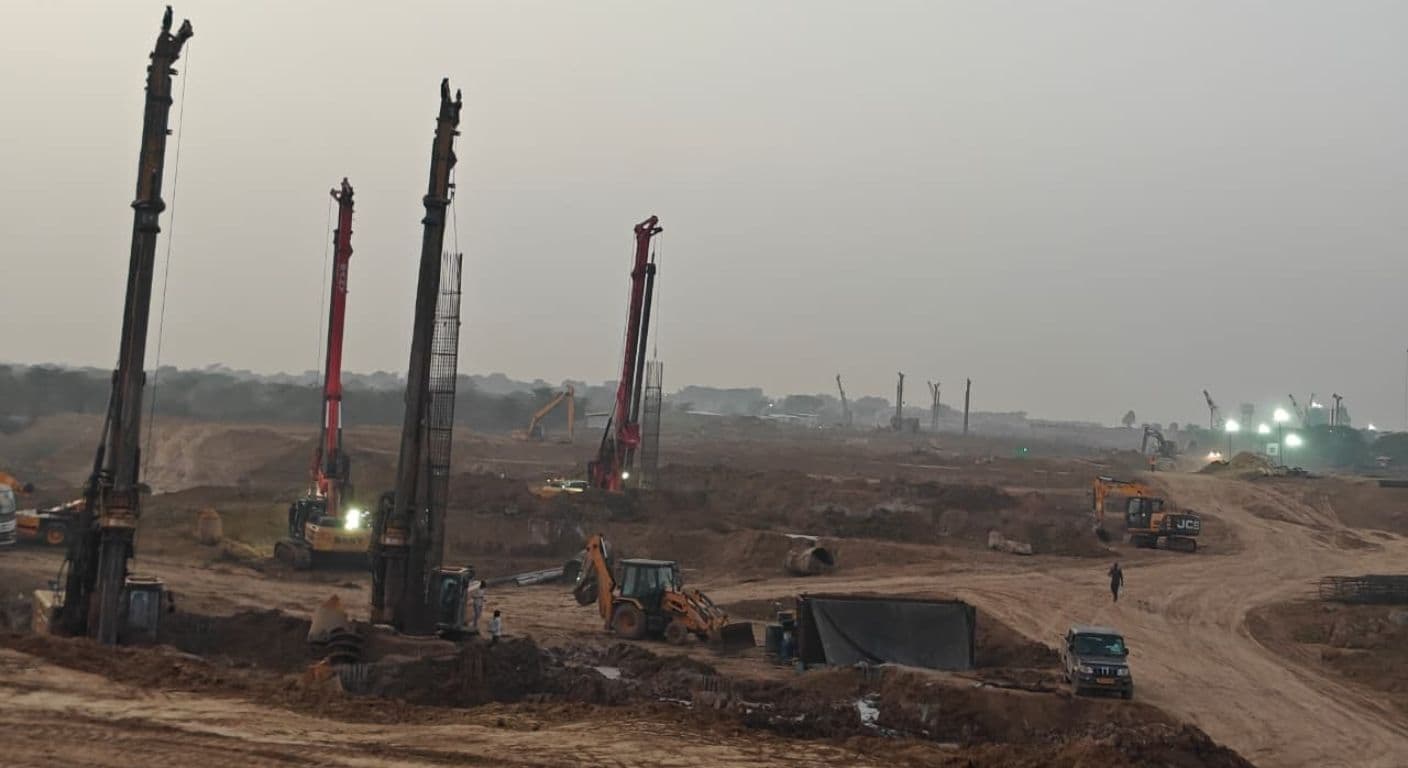
The proposed aqueduct has an internal width of 41.25 metres and a height of 7.7 metres, with a total length of 2,280 metres. Since the inauguration of work in May 2025, construction has advanced swiftly.
Approximately 90% of the camp and batching plant work at the construction site has been completed. Out of 15 proposed test piles, 8 test piles have already been completed. A total of 5,060 working piles are planned, of which around 860 piles have been completed so far. With the help of 12 rig machines, an average of 15–20 piles are constructed daily, along with nearly 500 cubic metres of concrete work per day. Construction activities are ongoing in continuous shifts to maintain momentum.
A Mega Project with Statewide Impact
By expanding the scope of the ERCP, the state government has developed the Ram Jalseetu Link Project with an estimated investment of ₹90,000 crore. In its first phase, the project will provide drinking water to nearly 3.25 crore people across 17 districts of Rajasthan. Additionally, it will support irrigation needs and industrial water supply, significantly boosting the state’s economic and social development.
Strong Inter-State Coordination
Notably, soon after the formation of the current state government, effective dialogue was initiated with the Government of Madhya Pradesh, leading to mutual consent. An MoU for the revised PKC scheme was signed in January 2024, followed by the exchange of a Memorandum of Agreement (MoA) on December 17, 2024, in Jaipur, in the presence of Prime Minister Shri Narendra Modi, between the Governments of Rajasthan, Madhya Pradesh, and the Government of India.
This achievement stands as a testament to Chief Minister Bhajanlal Sharma’s foresight, coordination skills, and unwavering commitment to public welfare.
A Lifeline for Rajasthan’s Future
The Ram Jalseetu Link Project is set to become a lifeline for Rajasthan, offering a permanent solution to water scarcity. Under the leadership of Chief Minister Shri Bhajanlal Sharma, the state is moving decisively toward water self-reliance, ensuring sustainable development and a secure future for generations to come.