
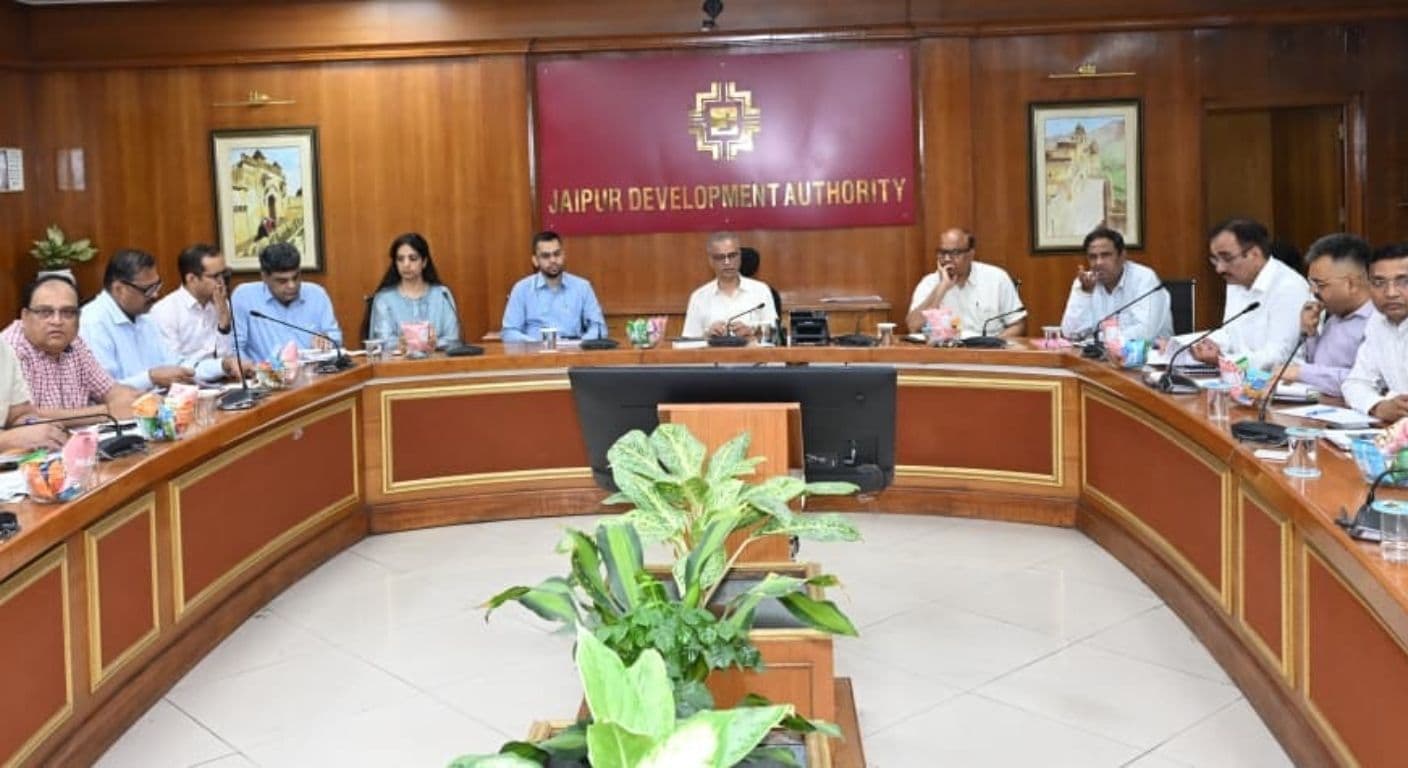
A Rs 575 crore urban works package has cleared administrative and financial approvals for a fresh set of projects across the city and the wider JDA area, led by a revised Rs 300 crore approval for an elevated road in the Sanganer corridor and a Rs 205.32 crore sewage treatment package at Nevta. The approvals were granted in a meeting chaired by Jaipur Development Commissioner Siddharth Mahajan.
The significance lies in the mix rather than any single headline. The package combines traffic infrastructure, sewerage expansion, road restoration and sports facilities, pushing several different civic bottlenecks forward in the same approvals round.
Quick Highlights
- Administrative and financial approvals worth around Rs 575 crore were cleared for city and JDA-area works.
- A revised Rs 300 crore approval was given for an elevated road from the Sanganer Circle side toward the Malpura Gate corridor.
- A Rs 205.32 crore package was approved for a 50 MLD sewage treatment plant at Nevta, a trunk main line and 10 years of operation and maintenance.
- A Rs 18.89 crore road under bridge was approved on the Jaipur-Sawai Madhopur railway line in the Sanganer area.
- Sports, road restoration and river-linked environmental works were also part of the package.
Where most of the money is going
The two biggest components are clearly the Sanganer elevated road and the Nevta sewerage project. Together, they account for the bulk of the package and show that the current urban push is focused both on easing movement and on expanding civic utilities.
| Project | Approved amount | What it covers |
|---|---|---|
| Sanganer elevated road | Rs 300 crore | Revised administrative and financial approval for an elevated road from the Sanganer Circle side via the Chordiya petrol pump stretch toward the Malpura Gate side |
| Nevta sewage package | Rs 205.32 crore | 50 MLD sewage treatment plant, trunk main line and 10 years of operation and maintenance |
| Sanganer railway under bridge | Rs 18.89 crore | Road under bridge on the Jaipur-Sawai Madhopur railway line between the Haldighati and Diggi-Malpura Road side in the Sanganer area |
| Mansarovar sports complex | Rs 25.59 crore | Development, operation and maintenance of a sports complex near Modern School in Mansarovar |
| Swarn Vihar sports complex | Rs 2.58 crore | Development, operation and maintenance of a sports complex in the Swarn Vihar JDA scheme |
| PHED road restoration Phase II | Rs 8.57 crore | Restoration and renewal of road cuts linked to pipeline work from Janpath and Shyam Nagar toward New Sanganer Road |
| Chomu area roads | Rs 6.26 crore | Construction, renewal and improvement of multiple roads in the Chomu assembly area |
| Dravyavati river-linked systems | Rs 5.12 crore | Treatment and hybrid solar power system work tied to environmental and water-management infrastructure |
Why the Sanganer and Nevta projects stand out
The Sanganer corridor approvals matter because they deal with one of the most visible pressure points in a fast-growing southern urban belt: how traffic moves through a zone with heavy road and railway interactions. The combination of a large elevated road approval and a separate under-bridge package suggests planners are trying to tackle both congestion and route continuity in the same broader area.
The Nevta sewage project stands out for a different reason. Sewerage investments are less visible than flyovers or elevated roads, but they usually carry longer-term value because they shape sanitation capacity, environmental management and future urban expansion. A 50 MLD plant with a trunk main line and long operations window signals a more system-level utility intervention rather than a short patchwork fix.
Sports and environmental works are part of the same push
The package also sets aside money for sports infrastructure, with approvals for facilities in Mansarovar and Swarn Vihar. Officials said both projects will be taken up on a DBOM basis, meaning the scope goes beyond construction and includes operation and maintenance as well.
That matters because it suggests the current approvals round is not limited to transport and sewerage alone. The inclusion of sports assets and Dravyavati river-linked environmental works points to a wider attempt to balance mobility, civic services and quality-of-life infrastructure within one planning cycle.
What happens next
These approvals do not mean the projects are finished or even immediately visible on the ground. What they do mean is that the administrative and financial path has been cleared for a significant set of works. The real test now is execution: tendering, timelines, construction progress and whether these sanctions translate into measurable relief for commuters, neighbourhoods and public services.
If the biggest items move on schedule, the package could improve traffic flow, sewerage capacity and community-level infrastructure. If execution slows, it will remain a large promise on paper. For now, the approvals offer a clear signal about where the next round of urban spending is being directed.