
On November 1st, a devastating tragedy occurred at the Neerja Modi School in Jaipur when Amaira, a 9-year-old Class 4 student, died by suicide after jumping from the fourth floor of the school building. In the aftermath, the Central Board of Secondary Education (CBSE) launched an investigation into the circumstances surrounding her death and the school's overall environment.
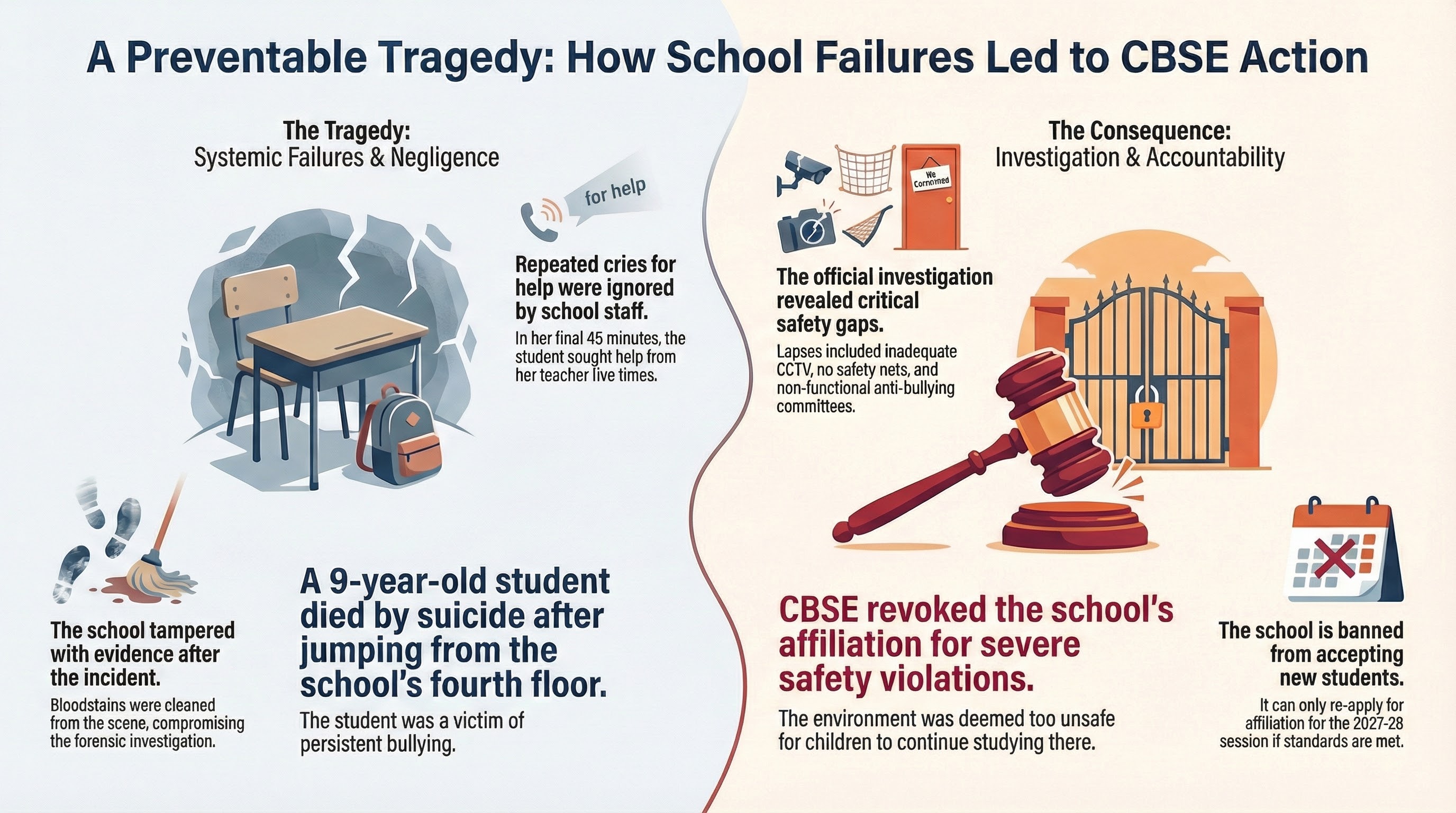
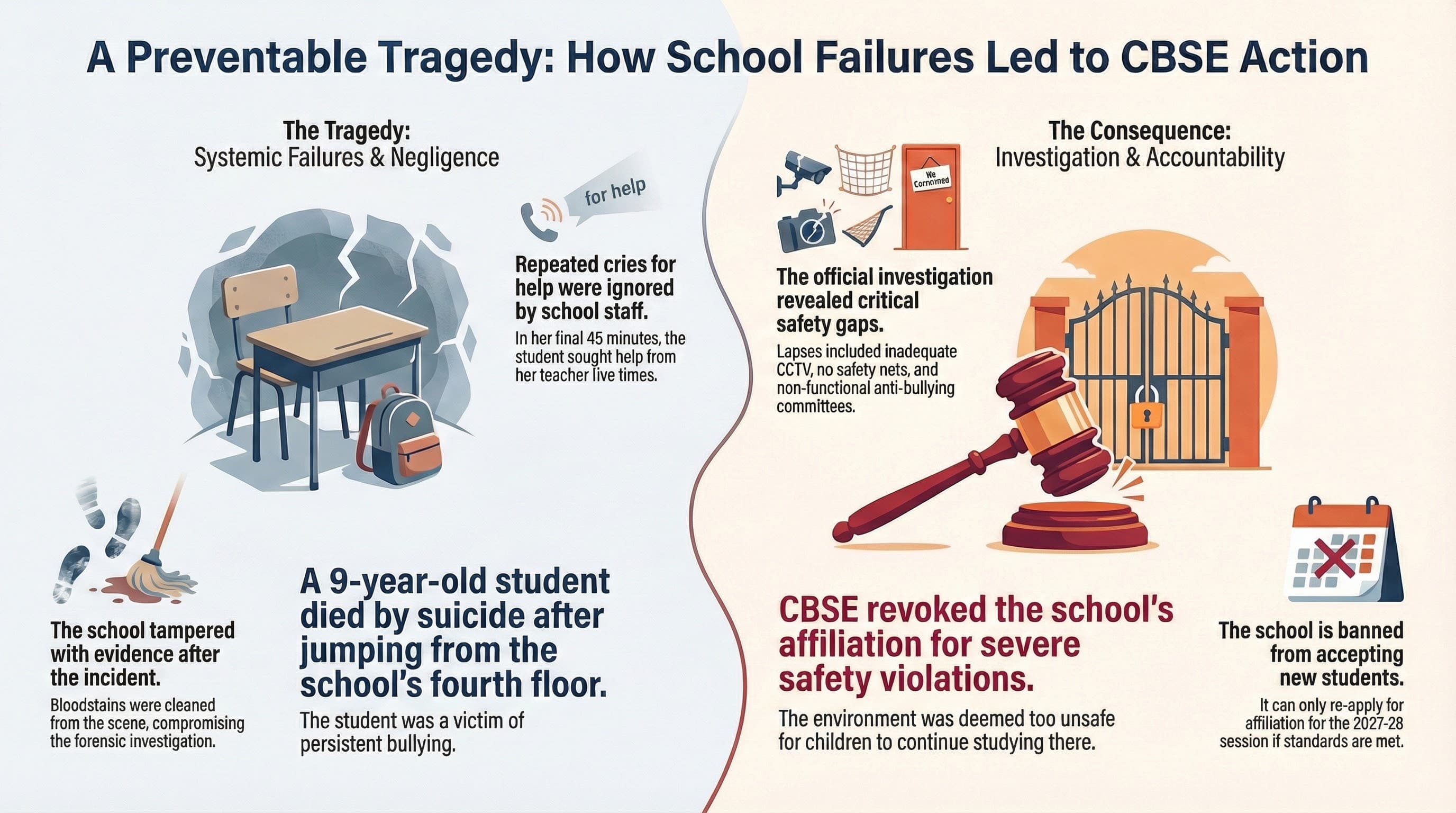
The CBSE's investigative report was damning. The board concluded that the school was an unsafe environment for children due to "serious violations of student safety standards." As a result, it took the severe step of revoking the school's affiliation, a decision that has significant consequences for its future operations. To understand this severe penalty, we need to look at the specific failures that led to this devastating outcome.
2. The Core Failure: Ignoring a Student's Cries for Help
The investigation revealed that Amaira's death was preceded by a prolonged period of distress and unanswered pleas for help. This was not a sudden incident but the culmination of a catastrophic failure by the school to fulfill its most basic duty of care.
- Persistent Bullying: Amaira was a victim of constant bullying at school. Her parents had formally complained to teachers and coordinators more than three times over a year and a half. Despite these repeated complaints, the school's Anti-Bullying Committee failed to take any action.
- Ignored Pleas for Help: The investigation's most devastating finding revealed the final, preventable failure in the school's duty of care. In the last 45 minutes before her death, Amaira approached her class teacher for help 5 separate times. Each time, she was ignored.
This direct failure to listen to a child in distress was a sign of deeper, systemic problems within the school's safety and support structures.
3. A System of Neglect: The Official Findings
The CBSE's surprise inspection and subsequent investigation uncovered a pattern of widespread negligence, revealing that the school violated multiple national safety guidelines. The committees meant to protect children existed only on paper, and the physical environment itself was hazardous.
The following table summarizes the key problems identified by the investigators:
| Area of Failure | Specific Problems Found by Investigators |
| Physical Safety | Upper floors lacked essential safety nets or strong railings. The CCTV surveillance system was inadequate. |
| Student Support | The school's counseling system was ineffective. The Anti-Bullying, POCSO, and Child Protection committees existed only on paper and were not functional. |
| Staffing & Monitoring | There was not enough staff assigned to different floors. Students and staff were not wearing ID cards, which weakened the monitoring system. |
Beyond these systemic failures in safety protocols, the school's actions immediately after the tragedy revealed an even more disturbing level of irresponsibility.
4. Obstructing the Investigation: A Serious Offense
Instead of cooperating fully with authorities, the Neerja Modi School administration actively hindered the investigation through a deliberate pattern of concealment. The CBSE report highlighted that school staff cleaned blood stains from the scene of the incident, an action that could have compromised the forensic investigation by destroying crucial evidence. Furthermore, the school leadership was profoundly uncooperative with the Education Department's official team. After being sent by the Education Minister, the investigating team was locked out of the premises and was left to knock on the gates for an hour and a half before being forced to leave without meeting the principal or management. The CBSE deemed these attempts to obstruct the inquiry "extremely serious," as they called the transparency of the entire process into question and demonstrated a profound lack of accountability.
Given the overwhelming evidence of systemic failure and obstruction, the CBSE imposed strict consequences on the school.
5. The Consequences: What Happens to the School Now?
The loss of affiliation carries immediate and long-term penalties for the Neerja Modi School, effectively halting its ability to operate as a CBSE-affiliated institution.
- No New Admissions: The school is completely banned from accepting new students in any grade.
- Board Exams: To avoid disrupting their education, current 10th and 12th-grade students (for the 2025-26 session) are permitted to take their board exams from the school.
- Student Transfers: Students in grades 9 and 11 will be transferred to other nearby CBSE schools starting from the 2026-27 academic session.
- Re-application: The school cannot reapply for CBSE affiliation until the 2027-28 session. Even then, it will only be considered if it can prove full compliance with all safety, monitoring, and student protection regulations.
6. A Strong Message on Student Safety
The CBSE's decision to revoke the Neerja Modi School's affiliation was based on one clear conclusion: this tragedy was entirely preventable. Had the school followed established protocols for physical safety, student monitoring, and responsive counseling, a young life could have been saved. This decisive action serves as a strong and unequivocal message to all educational institutions across the country that the safety and well-being of students is a non-negotiable priority, and failures to uphold this fundamental duty will result in the most severe institutional consequences, setting a clear precedent for accountability nationwide.