
A 10-year vision for AIIMS Jodhpur has placed global research, digital healthcare and patient-friendly services at the centre of the institute's next phase, alongside stronger clinical care and medical education.
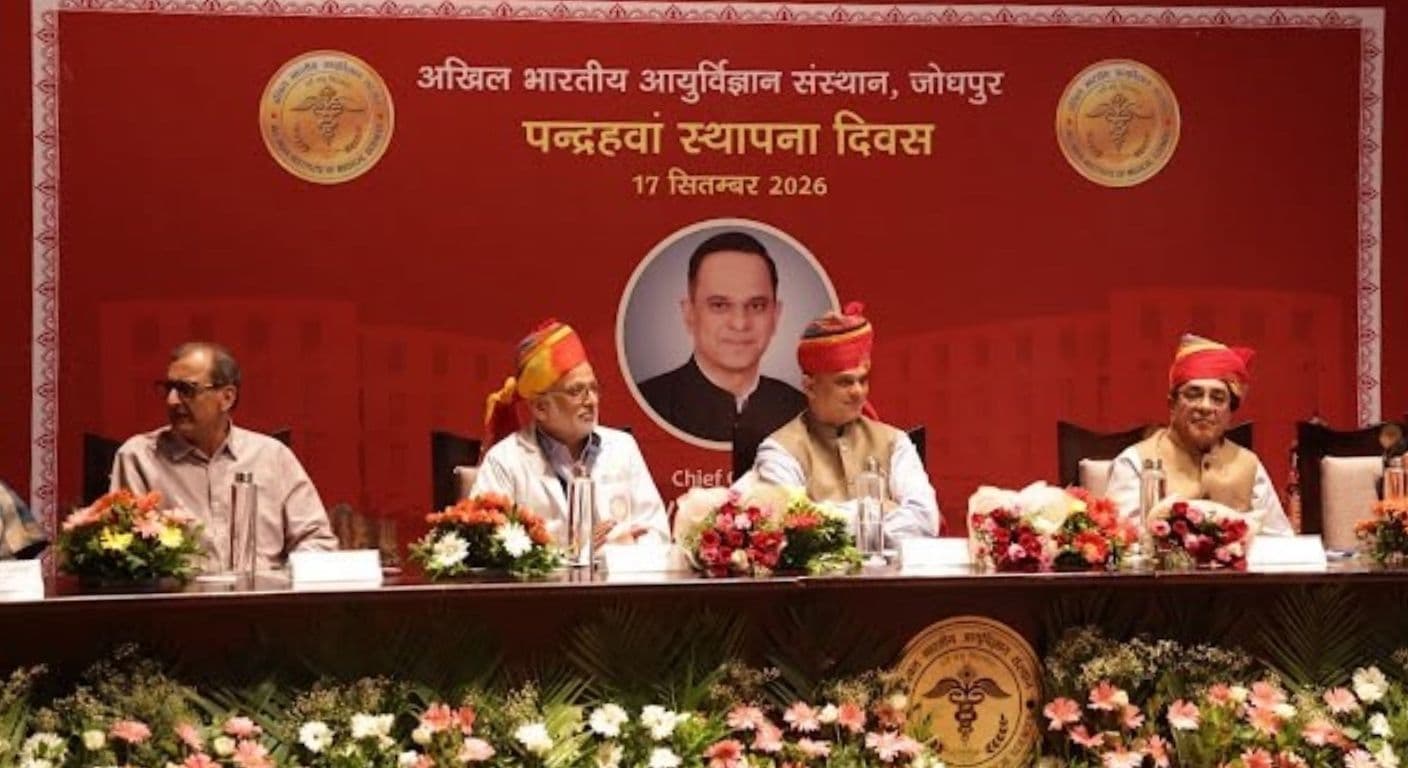
Rajasthan Chief Secretary V. Srinivas presented the priorities during the institute's Foundation Day lecture on September 17, 2026. The address described a direction for institution building rather than a set of newly funded projects or fixed completion dates.
AIIMS Jodhpur's current scale
Established in 2012, AIIMS Jodhpur now has 1,000 hospital beds, receives around 6,000 OPD patients and handles more than 250 emergency admissions each day.
Its specialised capabilities include paediatric cardiac surgery, TAVI, ECMO, bone marrow and stem cell transplantation, and IVF. These services have made the institute an important tertiary-care centre for patients across Rajasthan.
- Research: wider international partnerships and interdisciplinary work in genomics, artificial intelligence and public health.
- Clinical care: smoother OPD operations, stronger emergency triage and more multidisciplinary treatment.
- Digital systems: electronic medical records, linked laboratories and technology-enabled patient services.
- Education: more hands-on and simulation-based learning, supported by modern diagnostics and interaction with global experts.
Research, technology and the patient experience
The proposed research agenda includes global fellowships, stronger clinical cohorts and biorepositories, and greater visibility for AIIMS in high-impact medical research. International collaboration and work across disciplines were identified as central to that effort.
For clinical services, the vision calls for digitised records linked to a unique health identification, more efficient OPD workflows, stronger emergency triage and expanded multidisciplinary care. It also emphasises making treatment areas and support facilities easier for patients and families to use.
Artificial intelligence, digital therapeutics and remote patient monitoring were highlighted as emerging tools, while electronic hospital systems and interconnected laboratories were presented as more immediate foundations for better access, efficiency and quality.
Building strong teams remains another priority. Timely recruitment, reliable procurement, quality housing for doctors and paramedical staff, professional retention and stronger institutional decision-making were described as essential to long-term performance.
Medical education expands nationwide
The address also placed AIIMS Jodhpur's plans within the wider expansion of medical education in India. The number of government medical colleges was stated to have risen from 181 in 2014 to 441 in 2026, while the total number of medical colleges across the country reached 823 in 2026.
| Indicator | 2014 | 2026 |
|---|---|---|
| Government medical colleges | 181 | 441 |
| Undergraduate medical seats | 51,348 | 136,939 |
| Postgraduate medical seats | 31,185 | 86,360 |
For AIIMS Jodhpur, the education component includes regular curriculum reviews, additional simulation and practical training, exposure to global specialists and greater use of new diagnostics and technologies in clinical discussions.
The proposed direction combines these education priorities with research capacity and more responsive care. The next meaningful milestones will be the institute's specific programmes, budgets and timelines as the 10-year vision is translated into implementation.