
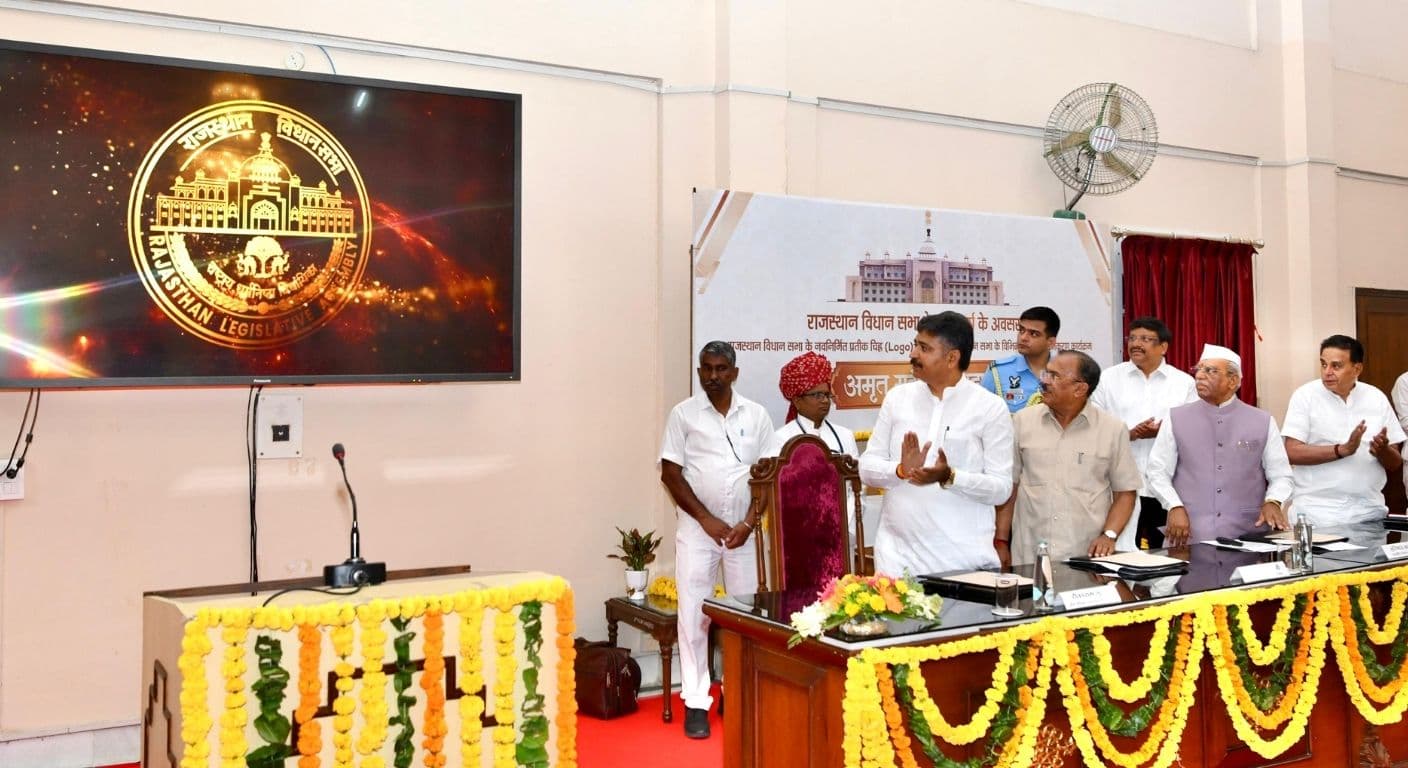
Jaipur's legislative complex added a new layer of symbolism, when Governor Haribhau Bagade unveiled a newly created emblem for the Rajasthan Legislative Assembly and also oversaw the naming of 13 gates at the complex. The ceremony was held as the Assembly marked its 75-year milestone, giving the event both institutional and cultural weight.
For Jaipur readers, the importance of the moment goes beyond ceremony. The Vidhan Sabha is one of the city's most visible public institutions, and changes to its emblem and gate naming shape how the Assembly presents its identity, history and relationship with Rajasthan's heritage to visitors, officials and citizens alike.
Quick Highlights
- The new Rajasthan Assembly emblem was unveiled in Jaipur on May 18, 2026.
- The Assembly complex also had 13 gates formally named during the event.
- The ceremony was linked to the Assembly's 75 years of institutional history.
- The emblem features symbols including Rohida, Khejri and the Vidhan Bhavan.
- The governor said the gate naming draws on places associated with Rajasthan's bravery and heritage.
What the new emblem is meant to represent
Bagade said the emblem prepared on the initiative of Assembly Speaker Vasudev Devnani reflects the thinking and spirit of Rajasthan's people. He highlighted the inclusion of the state flower Rohida, the Khejri tree and the image of the Vidhan Bhavan, describing the design as a visual expression of resilience, cultural memory and legislative identity.
That symbolism matters because it gives the Assembly a more region-rooted visual language. The governor connected Khejri to Rajasthan's ecological and historical consciousness, including the memory of Khejarli and the state's tree-protection tradition, while saying the inclusion of Rohida points to a culture of balance and coordination rather than a purely decorative design choice.
| Event element | What happened in Jaipur |
|---|---|
| Main ceremony | Unveiling of the new Rajasthan Assembly emblem |
| Assembly milestone | Marking 75 years of the institution |
| Additional action | Naming of 13 gates in the Assembly complex |
| Key design symbols | Rohida, Khejri and the Vidhan Bhavan |
How the event framed the Assembly's history
Bagade described the Assembly as a sacred house of democracy and used the occasion to place today's institution in a longer political timeline. He said that while the Assembly took formal shape in 1952 after Independence, Rajasthan had an earlier representative tradition dating back to 1913, when Maharaja Ganga Singh established a representative body before Independence.
That historical framing gives the Jaipur ceremony more substance than a routine logo launch. It positions the emblem as part of a larger effort to connect the present Assembly with both democratic continuity and Rajasthan's own pre-Independence political legacy.
Why the gate naming matters too
The naming of the 13 gates may sound administrative at first, but it is also a public-memory decision. The release says the selected names draw from places associated with Rajasthan's valor and cultural identity, which means the Assembly complex is being used not only as a working institution but also as a symbolic civic space.
Bagade also used the event to speak about discipline, practical conduct, education and the need to stay conscious of duties alongside rights in a democracy. For Jaipur, the next thing to watch is whether the new emblem and gate names remain a ceremonial gesture or become part of a broader effort to strengthen the Assembly's public identity and civic storytelling.