
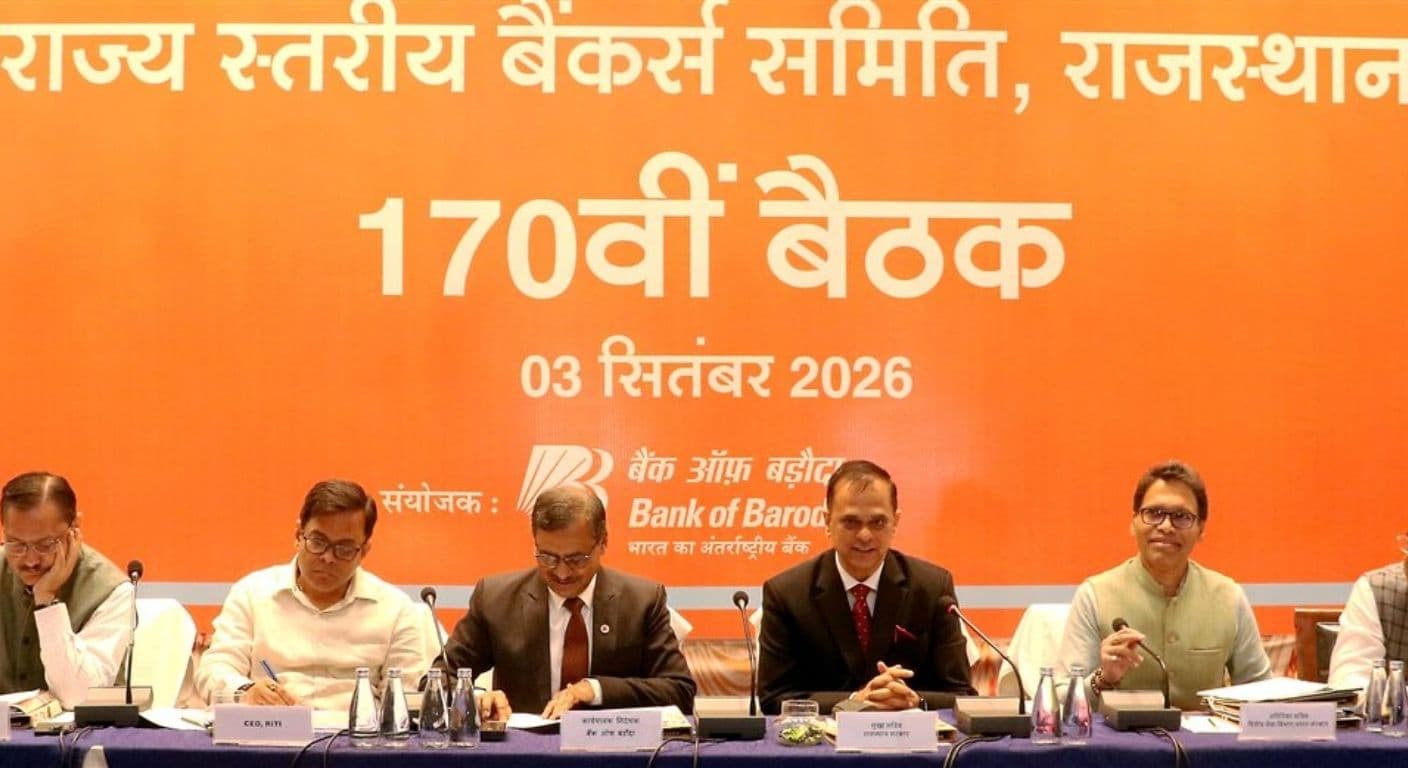
Rajasthan used the 170th State Level Bankers' Committee (SLBC) meeting, held in Jaipur on Thursday, September 3, 2026, to send a broad message to banks: credit growth alone is not enough unless it travels with financial inclusion, faster lending under government schemes and stronger cooperation against cyber financial crime. The meeting was co-chaired by Chief Secretary V. Srinivas and SLBC Chairman and Bank of Baroda Executive Director Sanjay V. Mudaliar.
The review matters across Rajasthan because it shapes access to formal banking, scheme-linked loans, land-record-backed credit and fraud-response systems. It also reviewed the Annual Credit Plan for 2026-27, making it a state-level checkpoint on whether banks are reaching households, entrepreneurs and employment-linked schemes in a practical way.
Quick Highlights
- The 170th SLBC meeting was held in Jaipur on September 3, 2026.
- Banks were asked to give financial inclusion as much attention as credit growth.
- Officials called for maximum loan disbursal under Central and State government credit and employment schemes.
- Priority-sector lending is to be reviewed in district-level DLRC and DLCC meetings.
- Banks, police and departments were asked to work in closer coordination against cyber fraud.
- The meeting reviewed the Annual Credit Plan 2026-27 and banks' performance under employment, financial inclusion and social security schemes.
- The state also highlighted the ULI linkage with the e-Dharti portal to simplify online land-record loan entries.
What the meeting focused on
The clearest direction from the meeting was that bank performance should not be judged only by bigger loan books. Srinivas said banks need to expand institutional financial services across all sections of society while also improving credit flow. That makes the discussion relevant to small businesses, rural households, first-time formal borrowers and people trying to access welfare-linked financial products across the state.
He also asked banks to maximize disbursal against applications received under credit-disbursement and employment-oriented schemes of both the Central and State governments. The broader objective, as framed in the meeting, is to support the growth path linked to Viksit Rajasthan@2047.
| Focus area | Direction from the meeting | Why it matters |
|---|---|---|
| Financial inclusion | Banks were asked to push access to formal financial services across all sections of society. | Wider access affects households, small borrowers and underserved communities directly. |
| Scheme-linked lending | Officials called for maximum disbursal under government credit and employment schemes. | Loan approvals under public schemes often shape business, self-employment and livelihood opportunities. |
| District monitoring | Priority-sector lending is to be reviewed in DLRC and DLCC meetings. | This creates a district-level follow-up mechanism instead of leaving the issue at a state meeting alone. |
| Cyber fraud response | Banks, police and departments were asked to coordinate more closely. | Faster coordination can matter when digital-banking fraud complaints need urgent action. |
| Land-linked lending | The ULI linkage with the e-Dharti portal was highlighted as a simplification step. | Online land-record workflows can reduce friction in loan processing tied to land documents. |
| Annual Credit Plan | The 2026-27 plan and bank performance under social and employment schemes were reviewed. | It sets the next benchmark for whether the banking system is delivering beyond headline targets. |
Why cyber fraud and digital lending access stood out
One of the more public-facing concerns in the meeting was cyber fraud. The Chief Secretary asked for active cooperation from banks to deal with the rise in cyber financial crime, arguing that coordination between banks, police and departments is essential if complaints are to be handled effectively.
Mudaliar also pointed to secure-banking efforts such as the 1930 Cyber Crime Call Centre visit and the Smart Banking and Safe Banking 2.0 campaign. Alongside that, the meeting highlighted the Unified Lending Interface linkage with the e-Dharti portal, which the state said has made the recording of loan-related land entries online and simpler. Together, those details show the meeting was not only about loan growth, but also about how the banking system works more safely and with less friction.
What happens next
The immediate next test will be whether district reviews through DLRC and DLCC meetings begin showing stronger priority-sector disbursal and better follow-through on pending scheme applications. The state also signaled that banks should maintain their current performance in the coming quarters rather than treat the September 3 meeting as a one-time review.
For the public, the useful markers will be practical ones: easier access to formal banking, faster loan decisions under government schemes, and more visible coordination when cyber fraud cases arise. Those outcomes will determine whether the state-level review turns into measurable improvement on the ground.