
Rajasthan says it has executed India's first rare-earth exploration licence, covering a 207.63 sq km block across Balotra and Jodhpur. The move matters because it formally opens an exploration phase for rare earth elements and associated minerals in a zone where the state says there are indications of lanthanum, cerium, praseodymium and neodymium.
This is an exploration step, not a mining-production announcement. That distinction is important. The immediate significance lies in scientific investigation and the possibility of building a stronger domestic critical-minerals pipeline, while the actual commercial value of the block will depend on what exploration work ultimately confirms.
Quick Highlights
- Rajasthan says it has executed the country's first rare-earth exploration licence.
- The licensed block covers 207.63 sq km across parts of Balotra and Jodhpur.
- The state says the area shows indications of lanthanum, cerium, praseodymium and neodymium.
- The contract has been executed with Central Mine Planning and Design Institute Ltd. after a successful auction.
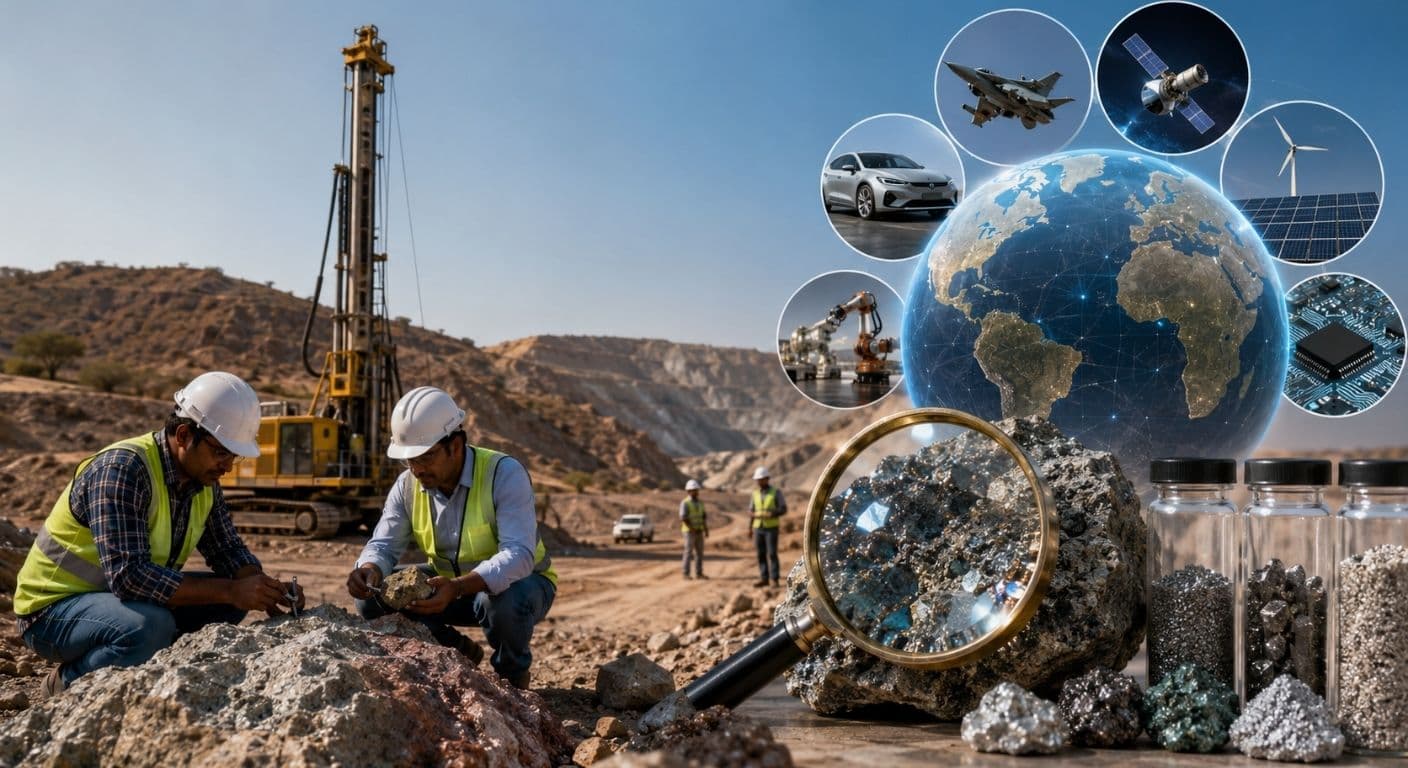
- Rare earth elements are strategically important for EVs, defence, space, renewable energy, semiconductors, electronics and telecom.
What has been cleared and where
The licence relates to a block identified in the release across the Pachpadra and Shergarh tehsil area, within the wider Balotra-Jodhpur belt. Rajasthan says the block was successfully auctioned during the first phase of exploration-licence auctions and that the state has now moved ahead with formal execution of the licence.
| Exploration item | Current detail |
|---|---|
| Licence type | Rare-earth exploration licence |
| Block size | 207.63 sq km |
| Block location | Balotra-Jodhpur area, including parts of Pachpadra and Shergarh |
| Entity named in the executed contract | Central Mine Planning and Design Institute Ltd. |
| Rare earth indicators cited | Lanthanum, cerium, praseodymium and neodymium |
The release also places this within a broader policy sequence. It says the Centre began auctions for critical and strategic minerals in 2024, while the first phase of exploration licence auctions began in 2025. Rajasthan is presenting this latest step as the first on-ground execution milestone to emerge from that process.
Why rare earths matter beyond the mining sector
Rare earth elements are not just another minerals story. They sit inside supply chains for technologies that now shape industrial policy and national capability, from electric vehicles and renewable energy systems to defence, space, electronics, telecom and semiconductors. That is why governments increasingly treat exploration in this category as a strategic step rather than a routine licensing event.
Rajasthan's mining department is also framing the licence as a way to accelerate scientific exploration and encourage private investment in critical minerals. If the exploration work yields meaningful findings, the block could become part of a larger push to strengthen domestic mineral security. If the findings are weaker than expected, the strategic importance of the licence will still remain, but the commercial upside would be more limited.
What happens next
The next phase is technical, not ceremonial. Exploration will need to establish the quality, spread and economic potential of any rare earth mineralisation before stronger conclusions can be drawn. In other words, the state has opened a new route into critical-mineral discovery, but it has not yet proved the block's eventual production value.
That makes this an important early-stage development for Rajasthan and for India's critical-minerals agenda more broadly. The licence is significant because it turns auction and policy language into an executed exploration right, and the real test now shifts to what the ground investigation actually finds.