
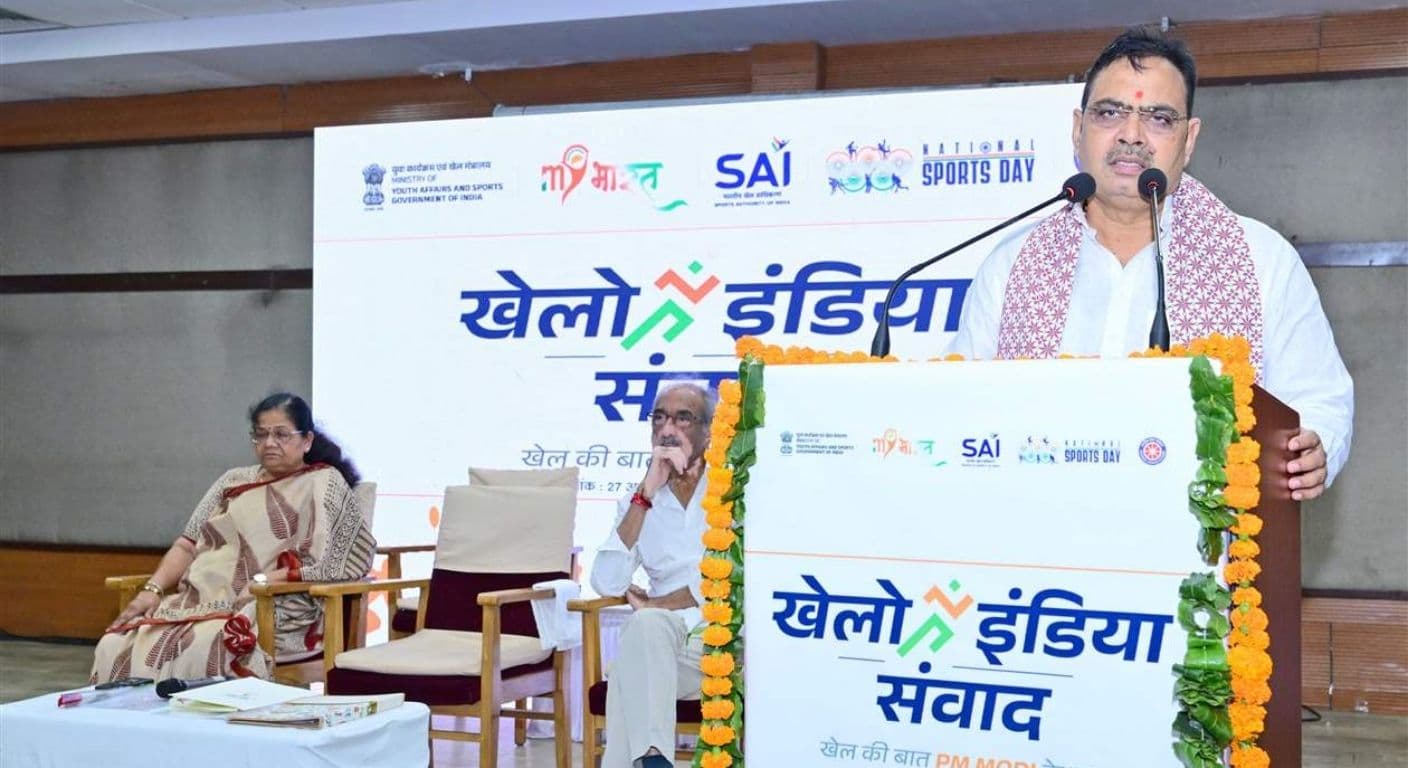
Rajasthan used a National Sports Day-linked My Bharat Khelo India dialogue on Thursday, August 27, 2026 to spotlight the scale of its sports build-out, from 50 Khelo India centres across the state to a planned Rs 101 crore Maharana Pratap Sports University in Jaipur. Chief Minister Bhajan Lal Sharma joined the programme via video conference from Subodh PG College, Jaipur and paired the sports update with fresh claims on athlete support, youth platforms and recruitment.
For Jaipur, the story matters because some of the most visible pieces of the sports push are anchored in the capital. The state said the Sawai Mansingh Stadium is getting a Centre of Excellence for athletics, archery and boxing, while the proposed university project would further tighten Jaipur's role as a sports-administration and training hub.
Quick Highlights
- Rajasthan said it has established 50 Khelo India centres.
- A Centre of Excellence for athletics, archery and boxing is being developed at Sawai Mansingh Stadium in Jaipur.
- A Maharana Pratap Sports University is being set up in Jaipur at a cost of about Rs 101 crore.
- The state said 3,540 athletes have received about Rs 52 crore in incentive and support payouts, while 186 athletes have been given government appointments.
- Rajasthan said it hosted the Khelo India University Games 2025 across 7 cities with participation from 222 universities and about 7,000 athletes.
- At the Khelo India Youth Games 2025, Rajasthan was said to have won 60 medals and finished third nationally.
What the sports package looks like
The release points to a mix of grassroots, high-performance and institutional measures rather than a single stadium-style announcement. Rajasthan is trying to show that sports development now stretches from district-level promotion and athlete allowances to elite training infrastructure and a university-scale project in Jaipur.
| Area | Figure or project | Why it stands out |
|---|---|---|
| Grassroots network | 50 Khelo India centres | Shows the state wants a wider training base rather than a capital-only model. |
| Jaipur high-performance infrastructure | Centre of Excellence at Sawai Mansingh Stadium for athletics, archery and boxing | Places Jaipur at the center of advanced training capacity. |
| Institutional expansion | Rs 101 crore Maharana Pratap Sports University in Jaipur | Adds a longer-term academic and sports-governance anchor. |
| Athlete support | 3,540 athletes given about Rs 52 crore; 186 athletes given government jobs | Links sports policy to direct financial and career support. |
| Hosting scale | Khelo India University Games 2025 in 7 cities with 222 universities and around 7,000 athletes | Shows Rajasthan is also positioning itself as an event host. |
| Competitive results | 60 medals and third place nationally at the Khelo India Youth Games 2025 | Gives the state a performance benchmark to point to. |
Two details are especially relevant for everyday athletes and families. The state said the mess allowance for players in departmental academies has been increased from Rs 2,600 to Rs 4,000 per month, and that a one district-one sport approach is being used to promote a designated sport in each district. Those are the kinds of measures that can affect participation well before any large showcase event arrives.
Why Jaipur sits at the center of the push
Jaipur's importance in the release is not just ceremonial. The capital is where both the high-performance and institutional pieces are being concentrated. If the Centre of Excellence at SMS Stadium becomes fully functional and the sports university moves ahead on schedule, Jaipur could deepen its role as the state’s core location for coaching, competition support and sports administration.
That also gives the city a wider relevance beyond hosting events. Sports infrastructure in Jaipur influences where young athletes train, which support systems become available, and how seriously Rajasthan can pursue long-term goals such as stronger Olympic-level preparation through the Rajasthan Target Olympic Podium Scheme.
How the youth message extends beyond sports
The programme also doubled as a broader youth-policy update. The state said about 65 percent of India's population is below 35 years of age and used the event to highlight digital and civic-participation platforms such as My Bharat and Rajasthan's own SuYog platform.
It also linked the sports narrative to employment and recruitment. The release said 410 recruitment exams have been conducted without a paper leak, that more than 1.89 lakh appointments have already been given, that recruitment is underway on more than 1.22 lakh posts, and that preparation is continuing for more than 70,000 additional posts. It also claimed that the private sector has generated jobs for more than 4.5 lakh young people. That broader framing suggests the government wants sports policy to sit inside a larger youth-opportunity story rather than stand alone.
What to watch next
The real test will be delivery. Announcing centres, athlete payouts, district schemes and a university project is one thing; turning them into sustained training quality, stronger results and visible local access is another. For Jaipur especially, progress on the SMS Stadium centre and the sports university will be the clearest markers of whether the headline numbers are translating into durable infrastructure.
For now, the August 27 programme matters less as a one-day event and more as a consolidated scoreboard of what Rajasthan says it is building in sports and youth policy. The figures are large, but the longer-term impact will depend on whether those promises become consistently visible on the ground.