

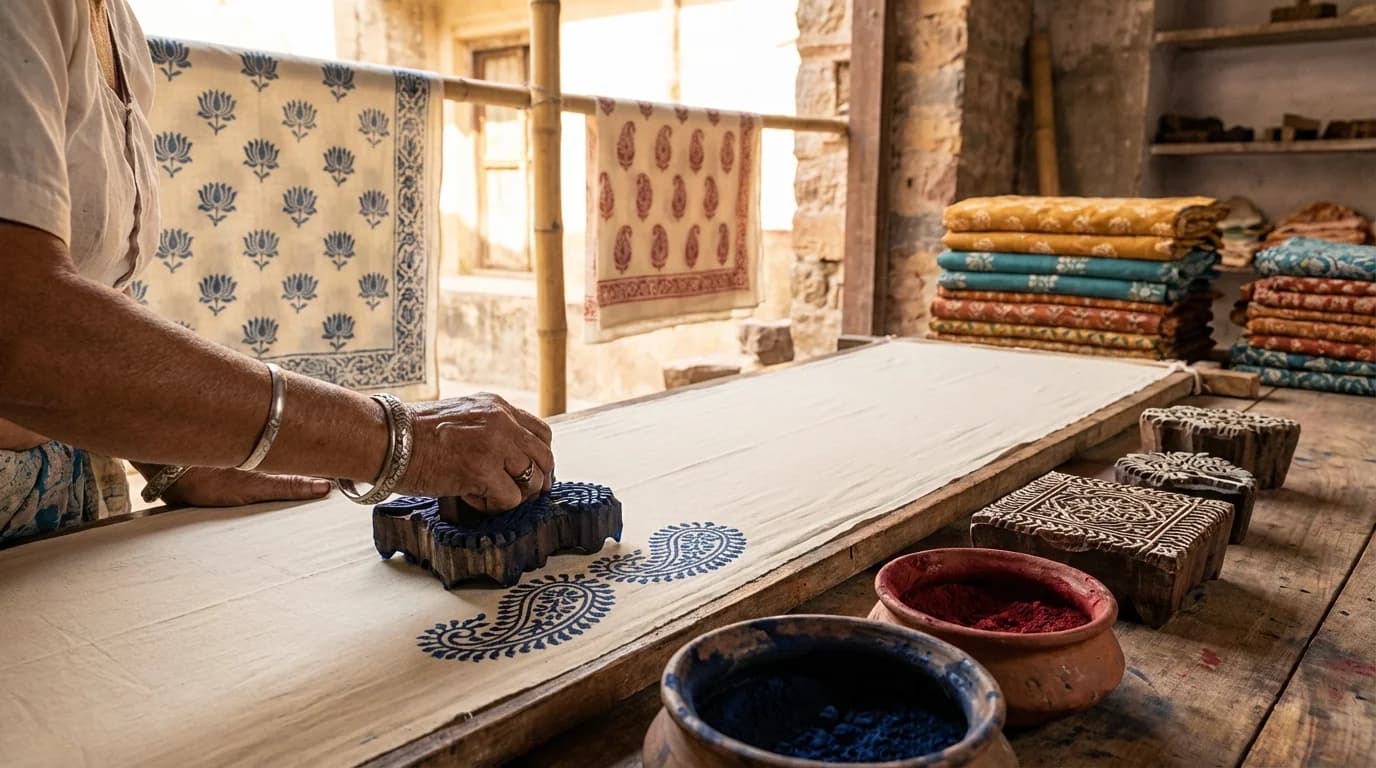
A Timeless Craft That Tells Jaipur's Story
If you've ever marveled at the beautiful hand-printed fabrics in Jaipur's bustling bazaars—those stunning bedspreads, sarees, and dupattas with intricate floral patterns—you've witnessed a craft that's been perfected over more than 500 years. Block printing isn't just a textile technique in Jaipur; it's a living heritage, a family tradition passed down through generations, and one of the most fascinating stories of Indian craftsmanship.
Let's take a journey through time and discover how this ancient art form found its home in the Pink City and continues to captivate the world today.
Ancient Roots: Where It All Began
The Indus Valley Connection
The story of block printing stretches back nearly 4,500 years to the Harappa and Mohenjo-Daro civilizations (around 2500 BCE). Archaeological evidence shows that these remarkable ancient societies already possessed:
- Knowledge of mordants – The chemical fixatives essential for making dyes permanent on fabric
- Natural pigment extraction – They skillfully extracted colors from plants and minerals
- Carved wooden blocks – The fundamental tool that would define this craft for millennia
What's particularly fascinating is that Rajasthan sits just a few hundred kilometers from these ancient sites. This geographical proximity suggests a direct cultural and technical inheritance—the craft quite literally traveled down through history to find its home in the region that would become Jaipur.
Early Patterns and Designs
The earliest block-printed textiles featured predominantly geometric patterns, reflecting the artistic sensibilities of the ancient world. These weren't just decorative—they held symbolic meaning, representing cosmic order, fertility, and protection. Some of these geometric motifs are still found in traditional Jaipur prints today, connecting modern artisans to their ancient predecessors.
The Royal Connection: How Mughal Patronage Transformed Block Printing
Akbar's Golden Age
While block printing existed for centuries, it truly flourished during the Mughal era. The 12th century saw the craft gain prominence in Rajasthan, but it was under Mughal patronage—particularly during Emperor Akbar's reign—that block printing reached new heights of sophistication.
The Mughals brought several transformative influences:
- Persian artistic influences – Elegant curves, flowing patterns, and sophisticated compositions
- Flora and fauna motifs – Replacing purely geometric designs with beautiful flowers, leaves, and animals
- Muslin fabric – The perfect lightweight canvas for detailed block printing
- Advanced dyeing techniques – More vibrant colors and better color permanence
Royal workshops were established where master craftsmen created exquisite textiles for emperors and nobility. This wasn't just decoration—it was a symbol of power, wealth, and refined taste. The finest block-printed fabrics were literally fit for kings and queens.
The Chhipa Community: Guardians of a Sacred Craft
Who Are the Chhipas?
At the heart of Jaipur's block printing tradition is the Chhipa community—a group of artisans whose very name comes from the Hindi word "Chhapa," meaning "to print" or "to stamp." For approximately 300 years, this community has dedicated their lives to perfecting and preserving this ancient craft.
The Chhipas didn't originate in Jaipur. Historical records suggest they migrated from Gujarat and other northern regions of India centuries ago, settling in small towns around what would become Jaipur. They brought their skills, their designs, and their deep knowledge of natural dyes—and they found the perfect home.
A Family Affair
Here's what makes the Chhipa tradition truly special: block printing is a hereditary craft. The knowledge isn't learned in schools or workshops—it's passed down from father to son, from grandmother to granddaughter, through generations of hands-on training that begins in childhood.
A young Chhipa child might start by helping mix dyes or clean blocks, gradually learning more complex tasks until they've mastered every aspect of the craft. By the time they're adults, they carry within them centuries of accumulated wisdom—the exact pressure needed to create a perfect impression, the precise timing for dye application, the subtle adjustments needed for different fabrics.
Today, an estimated 200+ families in the Bagru area alone work in block printing, with multiple community members involved in different production stages. It's not just a job—it's an identity, a way of life that defines who they are.
Sanganer and Bagru: Jaipur's Twin Capitals of Block Printing
Sanganer: The Hub of Delicate Elegance
Just 16 kilometers from Jaipur city center lies Sanganer, often called the "textile village" of Rajasthan. This small town has been a major hub for fine block printing for centuries, and walking through its streets is like stepping into a living museum of textile art.
What makes Sanganer special:
- Delicate floral patterns – Known for intricate flower designs including lotuses, marigolds, and jasmine
- Vibrant colors – Bright reds, deep blues, sunshine yellows, and fresh greens
- Fine, detailed work – Multiple colors requiring precise alignment of different blocks
- Light backgrounds – Often white or cream bases that make the colored prints pop
- Royal heritage – Historically produced textiles for Rajasthani royal families
Sanganer print got its start when skilled artisans moved here under royal patronage, creating a center of excellence that still thrives today. The town is also famous for its handmade paper, often decorated with pressed flowers—another testament to the creative spirit that defines this place.
Bagru: The Village of Earthy Traditions
About 35 kilometers southwest of Jaipur lies Bagru, a village that has developed its own distinctive block printing style over three centuries. If Sanganer is known for elegance, Bagru is celebrated for its earthiness and eco-conscious approach.
What makes Bagru unique:
- Earthy color palette – Deep indigos, rich blacks (kashish), warm browns, and natural cream
- Natural dyes only – Using madder, harda, turmeric, indigo, and pomegranate rinds
- The famous Dabu technique – A distinctive mud-resist printing method
- Geometric and nature motifs – Bold patterns inspired by the surrounding landscape
- Eco-friendly processes – Traditional methods that are naturally sustainable
In 2024, Bagru print received the prestigious Geographical Indication (GI) tag, officially recognizing this craft's unique and authentic nature. This designation protects traditional techniques from imitation and ensures that true Bagru prints come only from this region.
The Art of Dabu: Jaipur's Signature Technique
What is Dabu Printing?
Among the many block printing techniques, Dabu (also called "mud-resist printing") is perhaps the most distinctive and time-intensive. It's a method that perfectly embodies the patience, skill, and connection to nature that defines Jaipur's textile traditions.
Here's how the magic happens:
- Preparing the resist paste – Artisans mix local river mud with natural gum (from babul trees) and millet chaff (wheat bran) to create a thick paste
- Block printing the paste – Using carved wooden blocks, the paste is applied to fabric in the desired pattern
- Applying sawdust – The printed areas are sprinkled with sawdust to prevent smudging
- Dyeing – The fabric is dipped in natural dye; the mud-covered areas resist the color
- Washing and revealing – The mud is washed away, leaving beautiful negative-space patterns
- Repeating – For multiple colors, the process is repeated with different blocks and dyes
The result? Stunning fabrics with a distinctive, slightly crackled texture that you can't replicate with modern printing methods. The imperfections are part of the beauty—each piece is genuinely unique.
The Craft Process: From Tree to Textile
Creating the Blocks
The wooden blocks themselves are works of art. Master carvers (often from different communities than the printers) use hardwoods like:
- Teak (saagwan) – Durable and holds intricate details well
- Sheesham (Indian rosewood) – Traditional choice with excellent grain
- Rohida – A local Rajasthani wood perfect for fine work
Carving a single block can take days or even weeks, depending on complexity. The carver works with hand tools, chipping away the background to leave the design raised. Some patterns require multiple blocks—one for each color—that must align perfectly when printed.
Family workshops often have collections of hundreds of blocks, some over a century old, each telling its own design story.
Natural Dyes: Colors from the Earth
Traditional Jaipur block printing uses only natural dyes, extracted from plants, minerals, and even insects. This isn't just about being "eco-friendly"—these dyes create distinctive colors that synthetic alternatives simply cannot match.
Common natural dye sources:
- Indigo (Indigofera) – The famous deep blue that never fades
- Madder (manjistha) – Rich reds and rusty oranges
- Pomegranate rind (anar) – Warm yellows and greens
- Turmeric (haldi) – Bright sunshine yellow
- Kashish – An iron-rich compound creating deep blacks
- Harda (myrobalan) – Used as a mordant and for tan colors
Preparing these dyes is an art in itself, requiring precise knowledge of ratios, temperatures, and timing passed down through generations.
The Printing Process
Watching a master printer at work is mesmerizing. The rhythm is almost meditative:
- Fabric preparation – Cotton or silk is washed, sometimes treated with castor oil, and stretched on padded tables
- Dye preparation – Natural colors are mixed in shallow trays
- Block dipping – The printer dips the block into the dye tray, ensuring even coverage
- Stamping – With careful precision, the block is pressed onto the fabric
- Alignment – The printer moves systematically, ensuring patterns connect seamlessly
- Multiple colors – Different blocks are used for each color, requiring perfect registration
- Drying and washing – Multiple washes enhance color fastness
A skilled printer can stamp thousands of impressions in a day, yet each one requires the same focused attention. Too much pressure, and the dye bleeds. Too little, and the pattern is incomplete. The right touch comes only from years of practice.
The Patterns: Stories in Fabric
Traditional Motifs and Their Meanings
Every pattern in Jaipur's block-printed textiles tells a story. These aren't arbitrary designs—they carry deep symbolic meaning rooted in centuries of tradition:
- Lotus (kamal) – Purity, spiritual awakening, and beauty rising from muddy waters
- Jasmine (chameli) – Love, romance, and feminine grace
- Peacock (mor) – Prosperity, good fortune, and royalty
- Mango (keri/paisley) – Fertility, abundance, and the cycle of life
- Geometric patterns – Cosmic order and mathematical harmony
- Creeping vines (bel) – Growth, continuity, and interconnection
When a bride wears a block-printed saree at her wedding, or a family uses printed textiles during festivals, they're not just displaying beautiful fabric—they're connecting to centuries of meaning and tradition.
Surviving Against the Odds: Challenges and Revival
The Colonial Decline
Block printing's story hasn't always been one of triumph. During British colonial rule, factory-produced textiles flooded Indian markets. Machine-made fabrics were cheaper and faster to produce, and traditional artisans found themselves unable to compete.
Many Chhipa families were forced to abandon their ancestral craft, taking up wage labor in factories or other work. The craft that had flourished for centuries seemed destined to disappear.
Gandhi and the Swadeshi Revival
The tide turned during India's independence movement. Mahatma Gandhi's Swadeshi Movement championed Indian-made goods, and handcrafted textiles became symbols of national pride and resistance. Leaders like Kamla Devi Chattopadhyay worked tirelessly to revive traditional crafts, recognizing their cultural and economic importance.
Slowly, block printing came back. Artisan cooperatives formed, government support programs emerged, and a new generation began learning the old techniques.
Modern Challenges and Opportunities
Today, Jaipur's block printing faces a different set of challenges:
- Competition from screen printing – Faster and cheaper, though lacking the authentic touch
- Rising costs – Natural dyes and quality materials are expensive
- Skill preservation – Some young people prefer modern careers over traditional crafts
- Market pressure – Demand for quick, cheap products conflicts with slow, quality craftsmanship
But there's also tremendous opportunity. Growing global interest in sustainable, handmade, and ethical products has created new markets for authentic block prints. Fashion designers worldwide incorporate Jaipur prints into their collections. Tourists flock to Sanganer and Bagru to witness the craft firsthand.
Block Printing Goes Global
International Recognition
Today, Bagru and Sanganer prints are exported to countries including:
- United Kingdom
- United States
- Germany
- Japan
- Australia
- France
- And many more
High-end fashion houses feature Jaipur block prints in their collections. Interior designers use these fabrics for curtains, upholstery, and bedding. The distinctive aesthetic of hand-block printing—with its slight irregularities that prove human hands created it—has become increasingly valuable in a world of mass-produced sameness.
The GI Tag: Official Recognition
The 2024 Geographical Indication tag for Bagru print represents official recognition of what artisans have known for generations—that this craft is unique, valuable, and worthy of protection. Like Champagne wine or Darjeeling tea, true Bagru prints can now only come from their place of origin.
Experiencing Block Printing in Jaipur
Where to See It
If you're visiting Jaipur, experiencing block printing firsthand is a must. Here's where to go:
Sanganer:
- Just 16 km from Jaipur city
- Numerous workshops open to visitors
- Watch artisans at work
- Shop directly from producers
- Also famous for handmade paper
Bagru:
- 35 km from Jaipur
- More traditional, village atmosphere
- See the Dabu technique in action
- Visit family workshops
- Understand the natural dyeing process
In Jaipur City:
- Johari Bazaar – Traditional textiles and handicrafts
- Bapu Bazaar – Great for block-printed fabrics
- Anokhi Museum of Hand Printing – Educational exhibits about the craft
- Various boutiques and emporiums throughout the city
What to Buy
Block-printed products make wonderful souvenirs and gifts:
- Sarees and dupattas – Traditional wear with authentic prints
- Bedspreads and quilts – Beautiful additions to any bedroom
- Tablecloths and napkins – Bring Jaipur to your dining table
- Scarves and stoles – Lightweight, wearable art
- Dress materials – Fabric by the meter for custom clothing
- Bags and accessories – Everyday items with traditional flair
How to Spot Authentic Hand-Block Prints
With machine prints imitating hand-block styles, knowing how to identify authentic pieces is valuable:
- Look for slight irregularities – Perfect alignment usually means machine printing
- Check the reverse side – Hand-block prints show color penetration through the fabric
- Feel the texture – Dabu prints have a distinctive slightly stiff feel
- Examine the edges – Hand-printed designs have softer, less sharp edges
- Ask about dyes – Natural dyes have different qualities than synthetic ones
- Buy from workshops – Visiting artisan workshops guarantees authenticity
The Future of Block Printing in Jaipur
Preserving the Tradition
The future of block printing depends on balancing tradition with adaptation. Several positive developments give hope:
- Training programs – NGOs and government initiatives teaching young people the craft
- Design innovation – New patterns that appeal to contemporary tastes while respecting tradition
- Sustainable fashion movement – Growing demand for eco-friendly, handmade products
- Tourism – Visitors providing economic support and spreading awareness
- Online sales – Artisans reaching global markets directly
How You Can Help
Supporting Jaipur's block printing tradition is easier than you might think:
- Buy authentic – Choose genuine hand-block prints over machine imitations
- Pay fair prices – Quality craftsmanship deserves fair compensation
- Visit workshops – Tourism supports the local economy
- Spread the word – Share the stories behind your purchases
- Choose quality over quantity – One authentic piece is worth more than several cheap imitations
A Living Heritage
Block printing in Jaipur is more than just a craft—it's a living connection to human history. When you hold a hand-printed fabric from Sanganer or Bagru, you're touching something that links ancient civilizations to Mughal emperors to generations of Chhipa families to the artisan who carefully stamped that pattern just days ago.
In an age of fast fashion and mass production, there's something deeply meaningful about a craft that requires patience, skill, and generations of accumulated wisdom. Every imperfection in a hand-block print tells a story—of the human hand that made it, the traditions that guided it, and the centuries of history behind it.
The next time you see those beautiful printed fabrics in Jaipur's markets, take a moment to appreciate what you're really looking at: a 500-year-old story of art, tradition, and human creativity that continues to be written, one careful stamp at a time.
Frequently Asked Questions (FAQs)
How old is block printing in Jaipur?
While block printing techniques date back 4,500 years to the Indus Valley Civilization, the craft has been specifically practiced in the Jaipur region for over 500 years, with the Chhipa community maintaining the tradition for approximately 300 years.
What is the difference between Sanganer and Bagru prints?
Sanganer prints are known for delicate floral patterns on light backgrounds with vibrant, multiple colors. Bagru prints feature earthier tones like indigo and black, use only natural dyes, and often employ the distinctive Dabu mud-resist technique.
What is Dabu printing?
Dabu is a mud-resist printing technique where a paste made from local river mud, natural gum, and millet chaff is applied to fabric using wooden blocks. When the fabric is dyed, the mud-covered areas resist the color, creating beautiful patterns when washed away.
Are the dyes used in traditional block printing eco-friendly?
Yes! Traditional Jaipur block printing uses natural dyes extracted from plants and minerals—indigo, madder, pomegranate, turmeric, and others. These are completely biodegradable and environmentally friendly.
How can I tell if a block print is hand-made or machine-made?
Look for slight irregularities in alignment (perfect patterns suggest machine printing), check if color has penetrated to the reverse side, and examine the edges of designs (hand-printed edges are softer). Buying directly from workshops guarantees authenticity.
What is the GI tag for Bagru print?
In 2024, Bagru print received the Geographical Indication (GI) tag, which officially recognizes the craft's unique nature and protects it from imitation. Only prints actually made in Bagru using traditional techniques can legally carry this designation.
Where can I see block printing being done in Jaipur?
Visit Sanganer (16 km from Jaipur) or Bagru (35 km from Jaipur) to see artisan workshops. In the city, the Anokhi Museum of Hand Printing offers educational exhibits about the craft's history and techniques.
Who are the Chhipas?
The Chhipa community is a group of hereditary artisans whose name comes from the Hindi word "Chhapa," meaning "to print." They have practiced and preserved block printing for approximately 300 years, passing techniques from generation to generation.
