
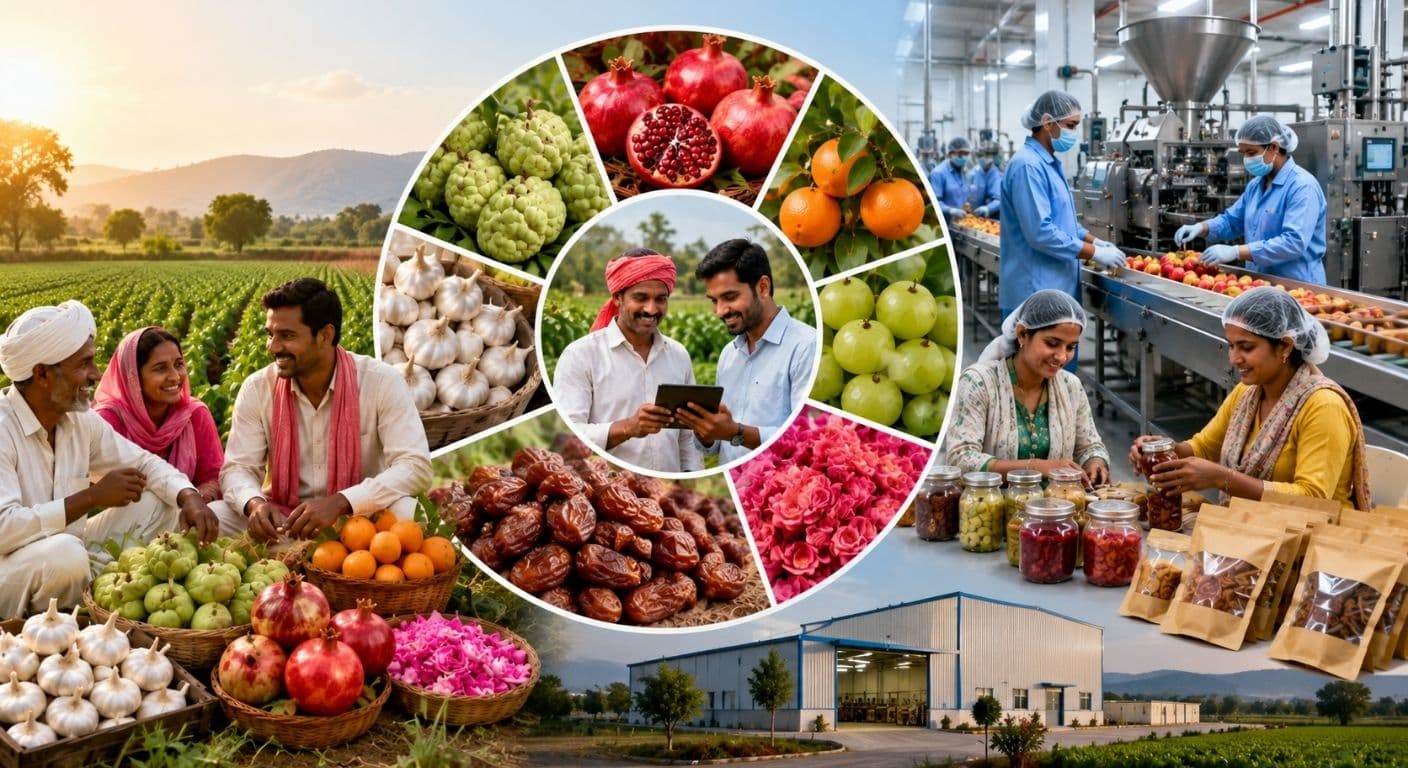
Rajasthan has cleared Rs 14 crore to set up seven crop-specific common incubation centres under its One District One Product Panch Gaurav programme, in a move aimed at pushing agriculture beyond raw produce and closer to local processing, value addition and branded market access. The centres are planned across seven districts and are meant to help farmers and local enterprises turn district-linked crops into better packaged and higher-value products.
The importance of the plan lies in the shared-facility model. Instead of expecting every farmer group or startup to build its own processing setup, the state wants common centres where grading, sorting, processing, packaging and labelling can happen at a more accessible cost. If the model works, it could give smaller producers a way into better markets without forcing them into heavy upfront capital spending.
Quick Highlights
- Rs 14 crore has been approved for 7 common incubation centres.
- The rollout is tied to the ODOP Panch Gaurav programme.
- The centres are planned for garlic, custard apple, pomegranate, orange, amla, rose and dates across seven districts.
- Facilities are expected to include grading, sorting, primary processing, value-added processing, packaging and labelling.
- The centres are meant to serve farmers, FPOs, self-help groups, startups and micro entrepreneurs.
Where the seven centres are planned
The rollout is based on district-product pairings rather than a generic statewide design. Rajasthan says the centres will reflect crop concentration and local production strength in each district, which is important because the processing and branding needs of one product can be very different from another.
| District | Crop planned for the incubation centre |
|---|---|
| Baran | Garlic |
| Chittorgarh | Custard apple |
| Jalore | Pomegranate |
| Jhalawar | Orange |
| Jaipur | Amla |
| Ajmer | Rose |
| Jaisalmer | Dates |
That district spread matters because it gives the programme a broader rural-enterprise shape instead of concentrating support in a single belt. Jaipur is part of the list through the planned amla centre, but the larger story is that the state is trying to create product-linked processing nodes across multiple agricultural and horticultural regions.
What the shared-facility model could change
The release says the centres will provide modern infrastructure for grading, sorting, primary and value-added processing, packaging and labelling. For many small producers, that is the most relevant part of the announcement. Access to these services can determine whether a product reaches the market as a low-value raw crop or as something that lasts longer, looks better, travels farther and earns more.
The plan is also meant to reduce a common barrier for smaller enterprises. Farmers, FPOs, self-help groups, startups and micro entrepreneurs often cannot justify setting up a full processing unit in the early stage. Shared infrastructure can lower that entry barrier and help new businesses test products, improve quality and build market presence before making larger independent investments.
Training, branding and market access are part of the pitch too
These centres are not being pitched only as machine rooms. Rajasthan says they will also work as live demonstration and training hubs where participants can learn food-processing techniques, quality standards, food safety, packaging, labelling, branding, marketing and business management. That could matter just as much as the physical equipment, because many value-addition problems begin with technical know-how and market readiness, not only with missing hardware.
The state also says the programme should help district-specific products move from local markets towards wider national reach through stronger branding and better presentation. If that happens, the centres could do more than improve post-harvest handling. They could help create local agri-enterprise clusters with better farmer returns, lower wastage and stronger rural employment. The next real test, though, will be execution: how quickly the centres are built, how well they are run and whether smaller producers actually find them usable in practice.